- Bad Naturalist Newsletter
- Posts
- Burn, Baby, Burn
Burn, Baby, Burn

Paula Whyman
April 26, 2026
Geek out with me about critters and plants on a mountaintop in Virginia. I’ll share what I’m learning as I try to bring native plants back on 200 acres of old farmland and tell stories from my encounters on the mountain.
Want to subscribe? (It’s free!)
Want to read it first? (I don’t blame you.)
In this issue
Field notes: Burn day!
Signs of life: How does your garden grow?
Recommended reading
Book news
The Official Mountain Poodle
I’ve written a book about what I’m doing and what I’m discovering here on the mountain…
BAD NATURALIST: One Woman’s Ecological Education on a Wild Virginia Mountaintop
Have I mentioned, BAD NATURALIST is a
Finalist for the Philip D. Reed Environmental Writing Award
Field Notes
Burn day!
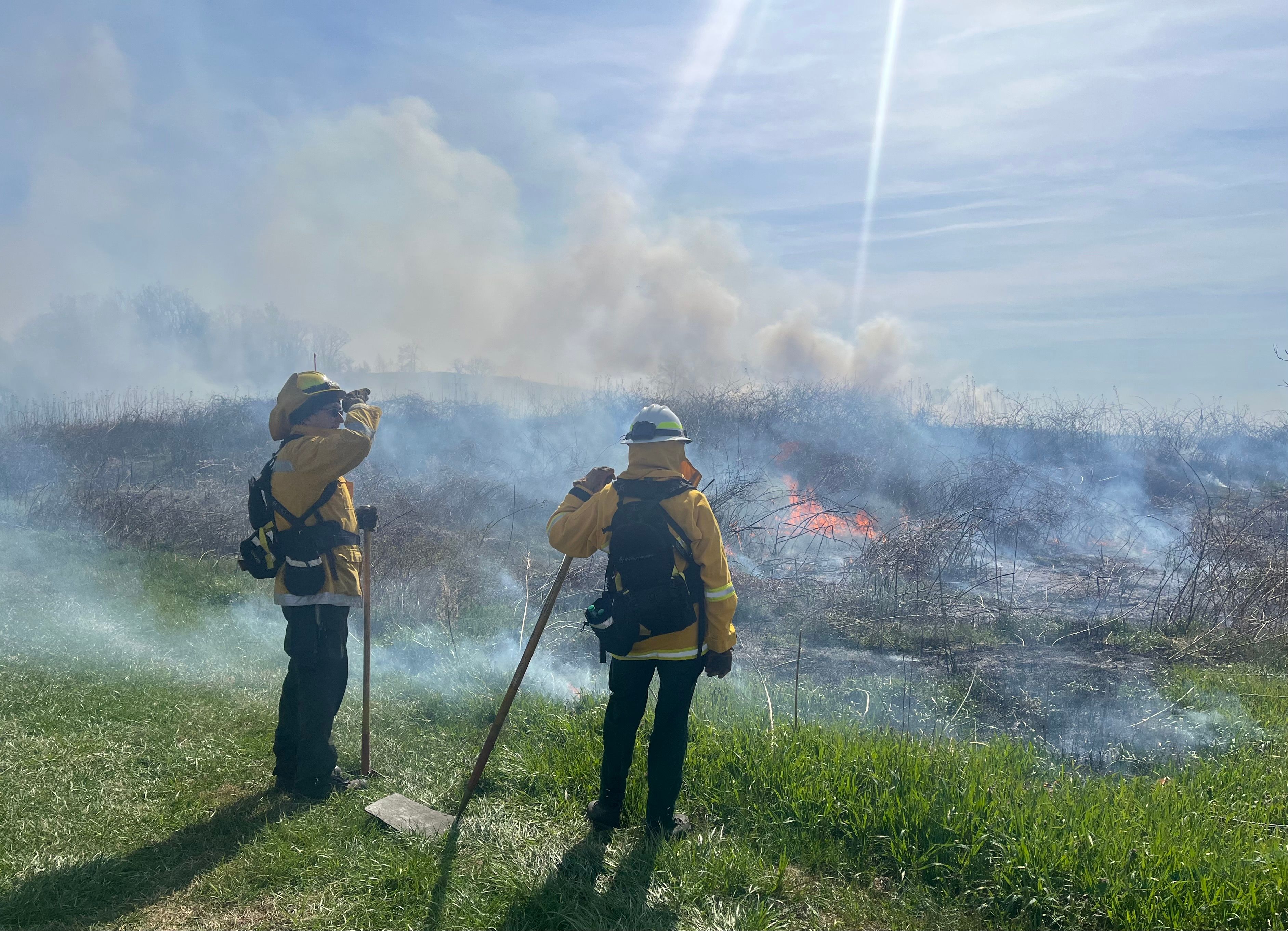
Yes, it finally happened! In early April, I got the call I’d been waiting for since November 2025—or really, since the last burn here in March of 2023. On a partly cloudy day with a mild breeze, a crew of seven, including foresters and volunteers, arrived to burn a nine-acre field in the central part of the mountaintop meadows. The field is a mix of nonnative and native grasses, blackberry bramble, and assertive native plants like crownbeard and dogbane, plus a large oak, occasional black cherry trees, and a small grove of young locust and poplar trees. It’s relatively flat, compared with other fields here, except as it stretches back toward the woods’ edge, where it slopes precipitously. A bit of a challenge. Adding to the challenge, the early spring growth that has happened everywhere—two weeks earlier than usual in a wide swathe of the U.S.—had hit the mountain as well. What might have been a more straightforward burn in March was complicated by a lot of new green growth, including grass and leaves beginning to open. The moisture retained by the new plants made for a particularly smoky burn, and a patchy one. When the fire bypassed patches of bramble and grasses, the foresters attempted to light the spots directly, often to no avail. If you look at the burned field from a high point on the mountain, you can see the blackened areas interspersed with large clumps of bramble and plants that look dead and dry but did not burn. This is not a failure! Wildlife like patchy habitat—they get thin spots to search for food and dense areas for nesting and hiding from predators. During the burn, one of the foresters protected a woodcock nest and a box turtle until the flames subsided.
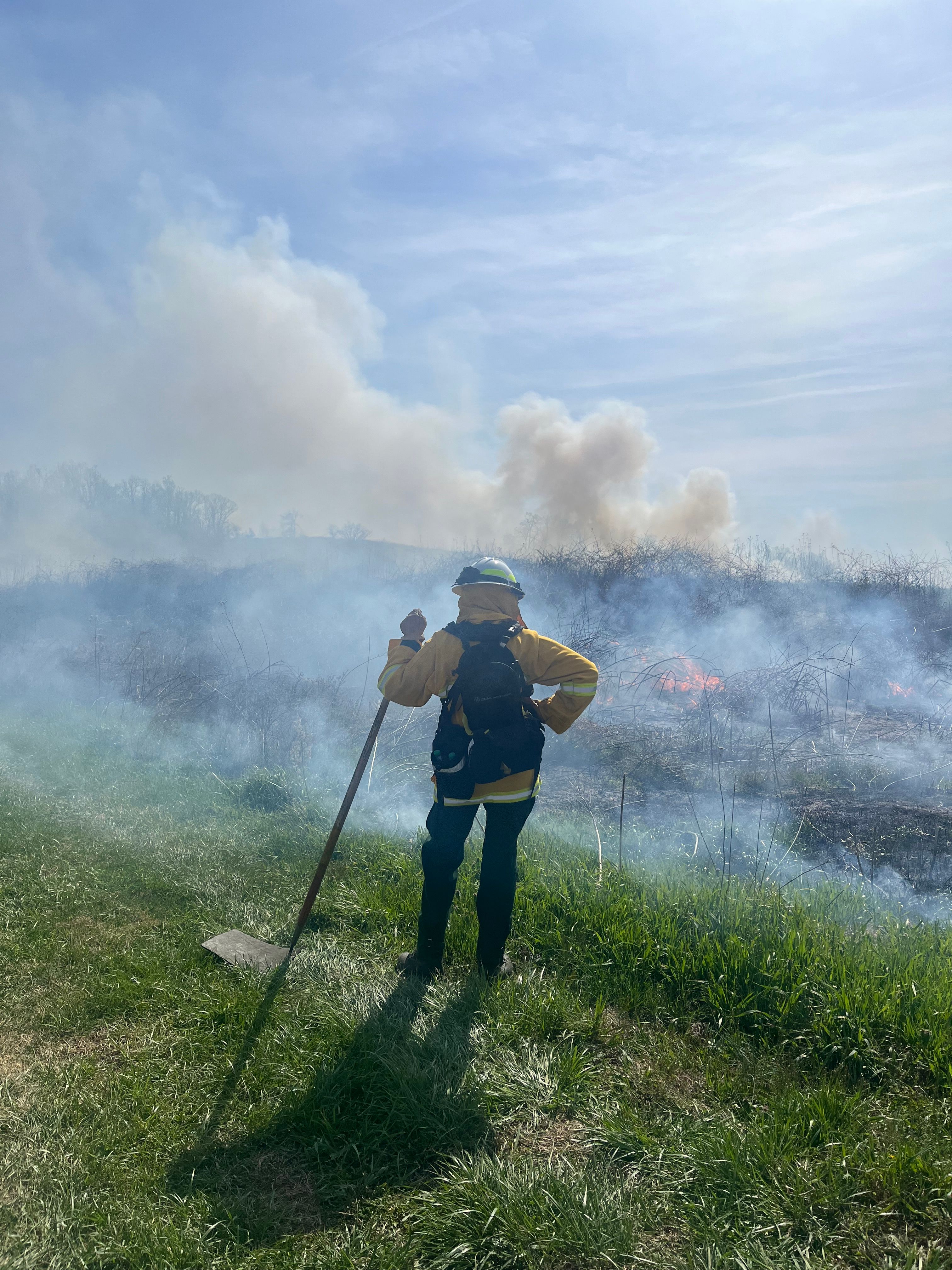
A volunteer minds the fire
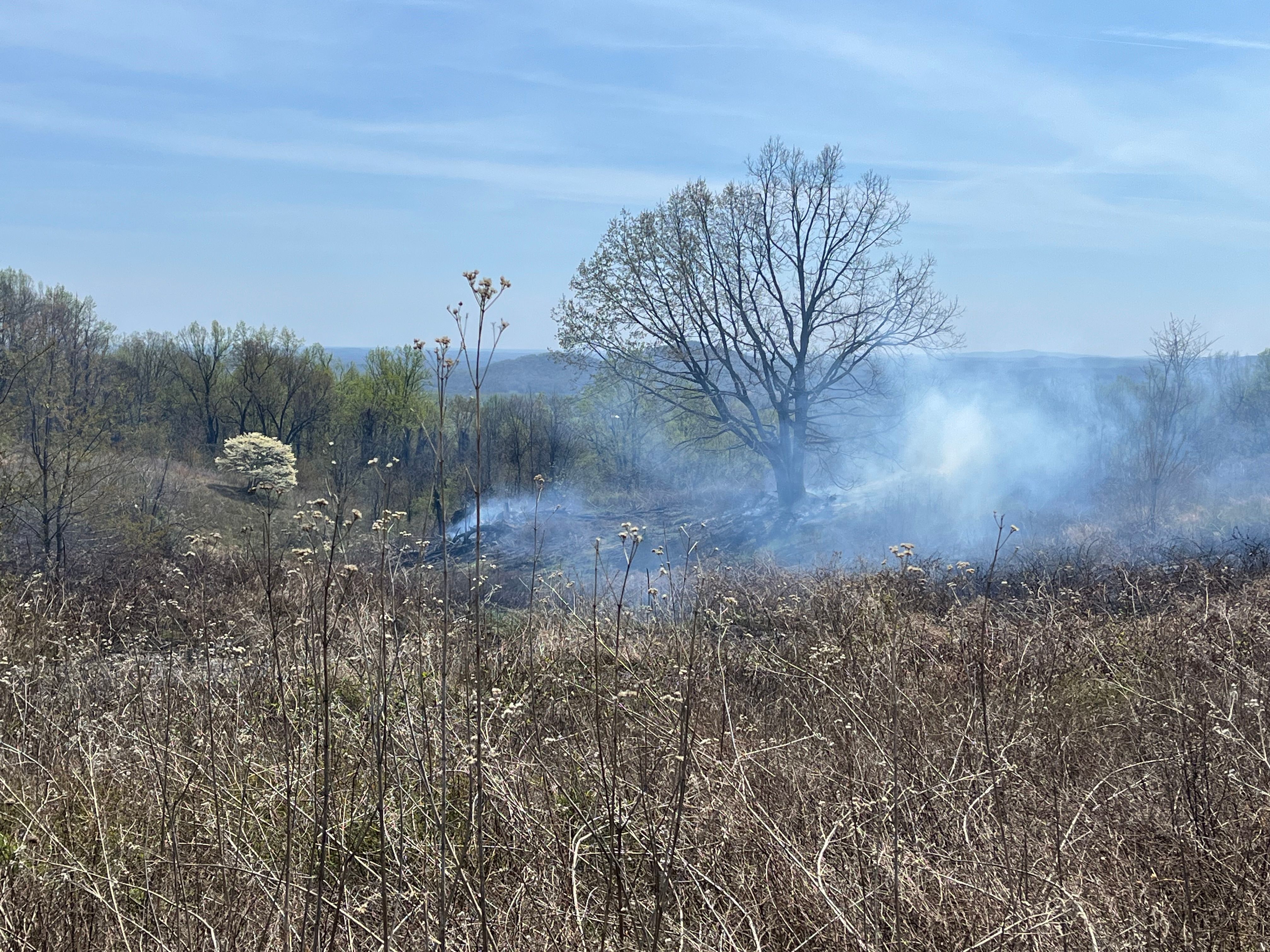
The ground around an oak continued to smolder for hours after the fire was out. (Bonus dogwood in bloom in the adjoining field.)
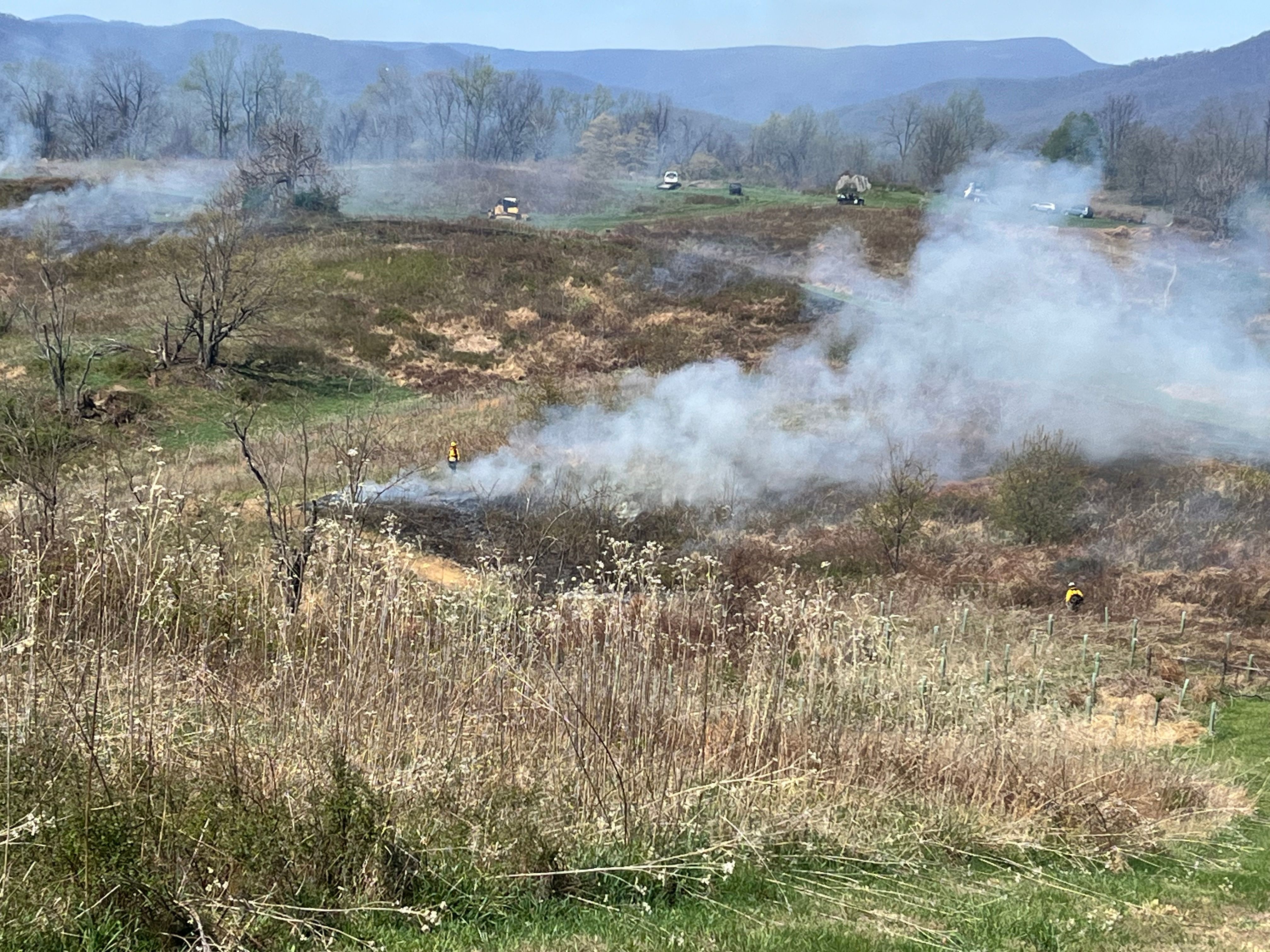
The way it looked from a high point as the burn wrapped up.
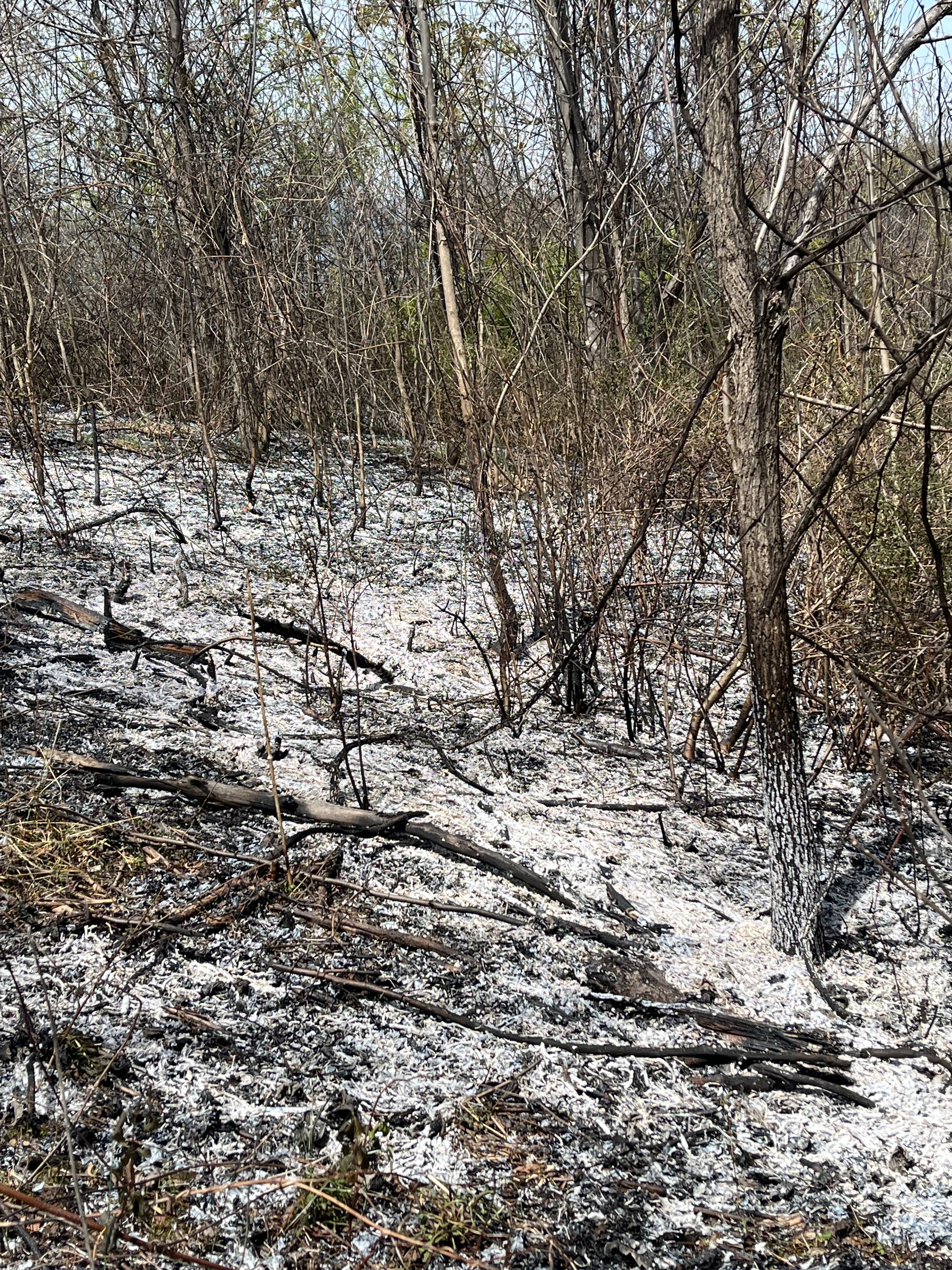
The burn eliminated undesirable vegetation in a small woodland patch.
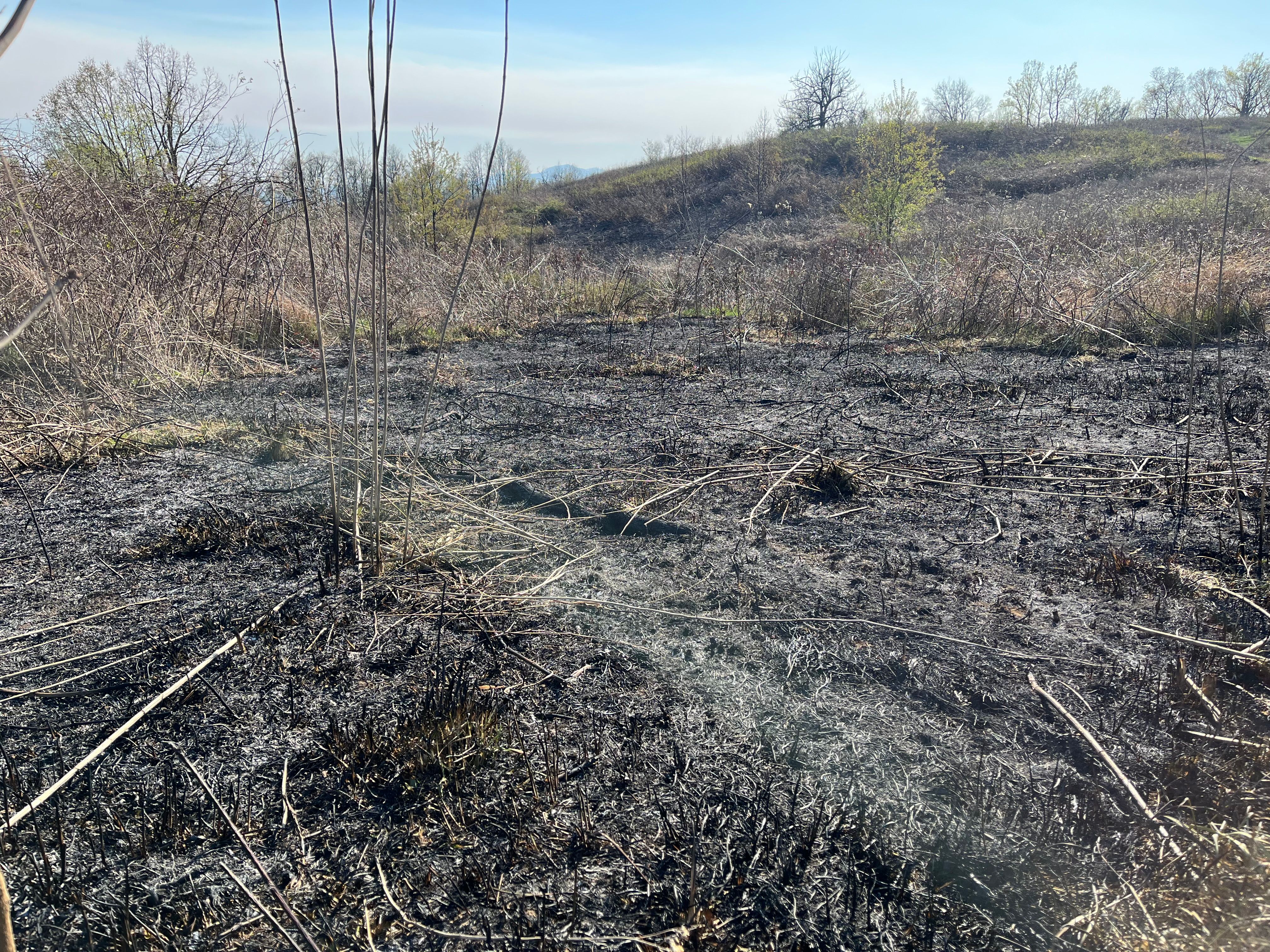
A burned patch bordered by vegetation that did not burn.
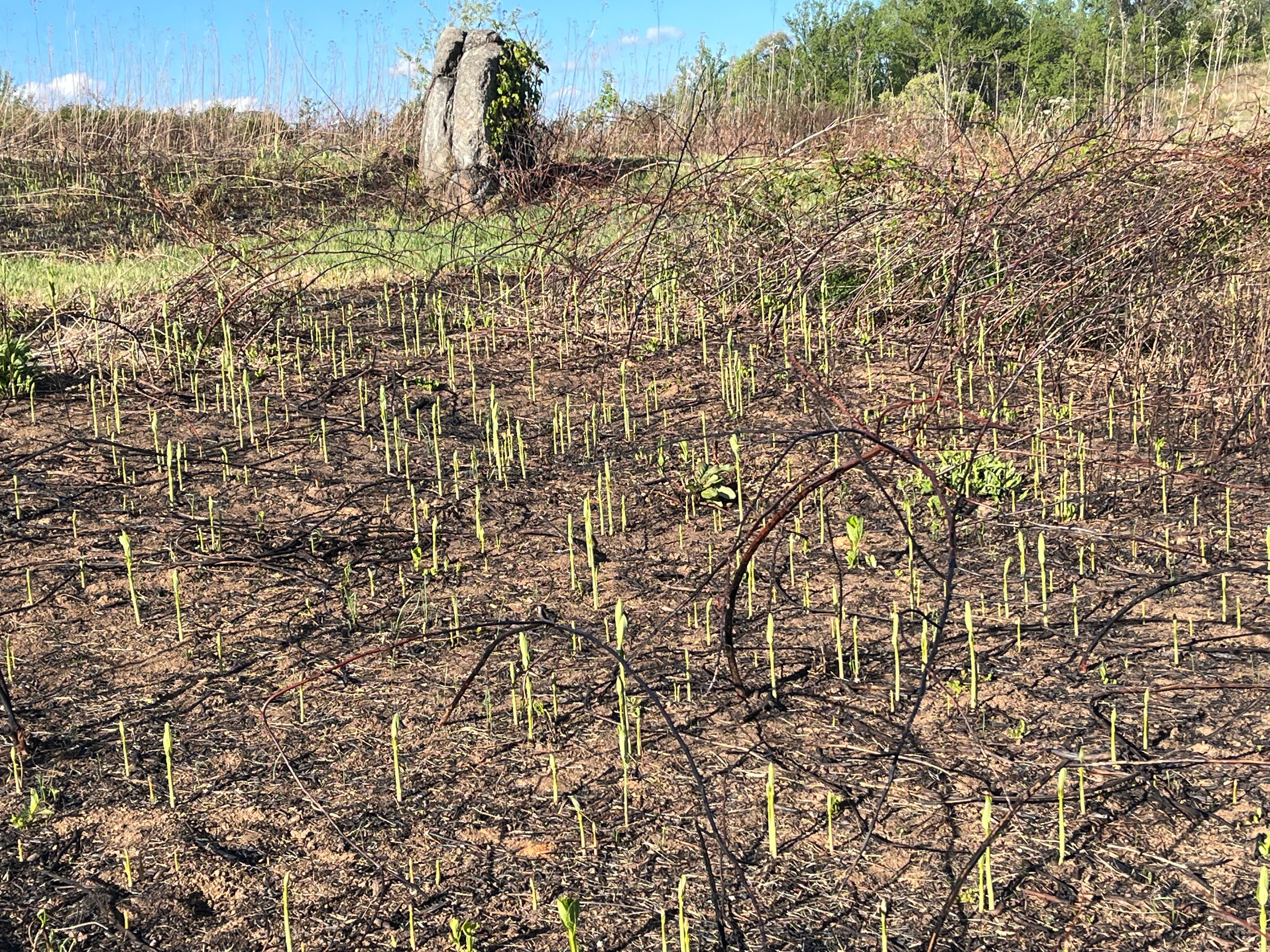
New plants coming up in one of the burned patches a couple of weeks later. (Mostly dogbane and some crownbeard.)
A profusion of dogbane and crownbeard are growing in some of the burned patches. Those are native plants, so I say bring it on! Meanwhile, I’m hoping to see more variety now that thatch in those areas is cleared out.
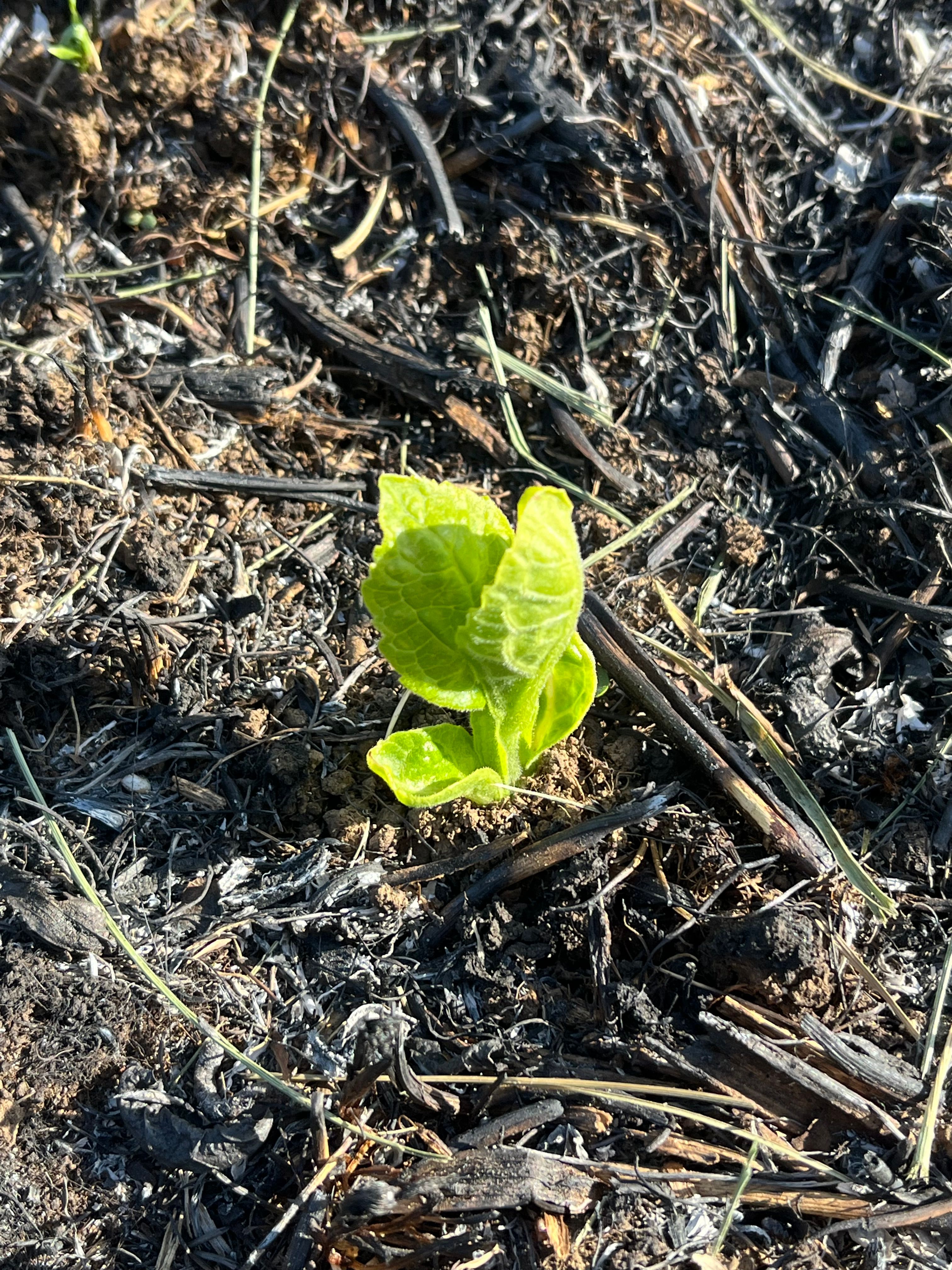
Crownbeard growing in burned soil
Here’s a good reminder that when you burn you’re likely to get more of what was there before. Some of that will be good and some won't. There was a lot of nonnative crownvetch in the meadow before. Welp, no surprise, it’s coming back. In some parts of the country it’s considered invasive. Here it’s prolific enough that when I see it in a place that’s easy to access, or in the native garden that’s planted around our house, I try to pull it. But in other parts of the meadow, I let it go, because it will eventually be outgrown by a profusion of native plants.
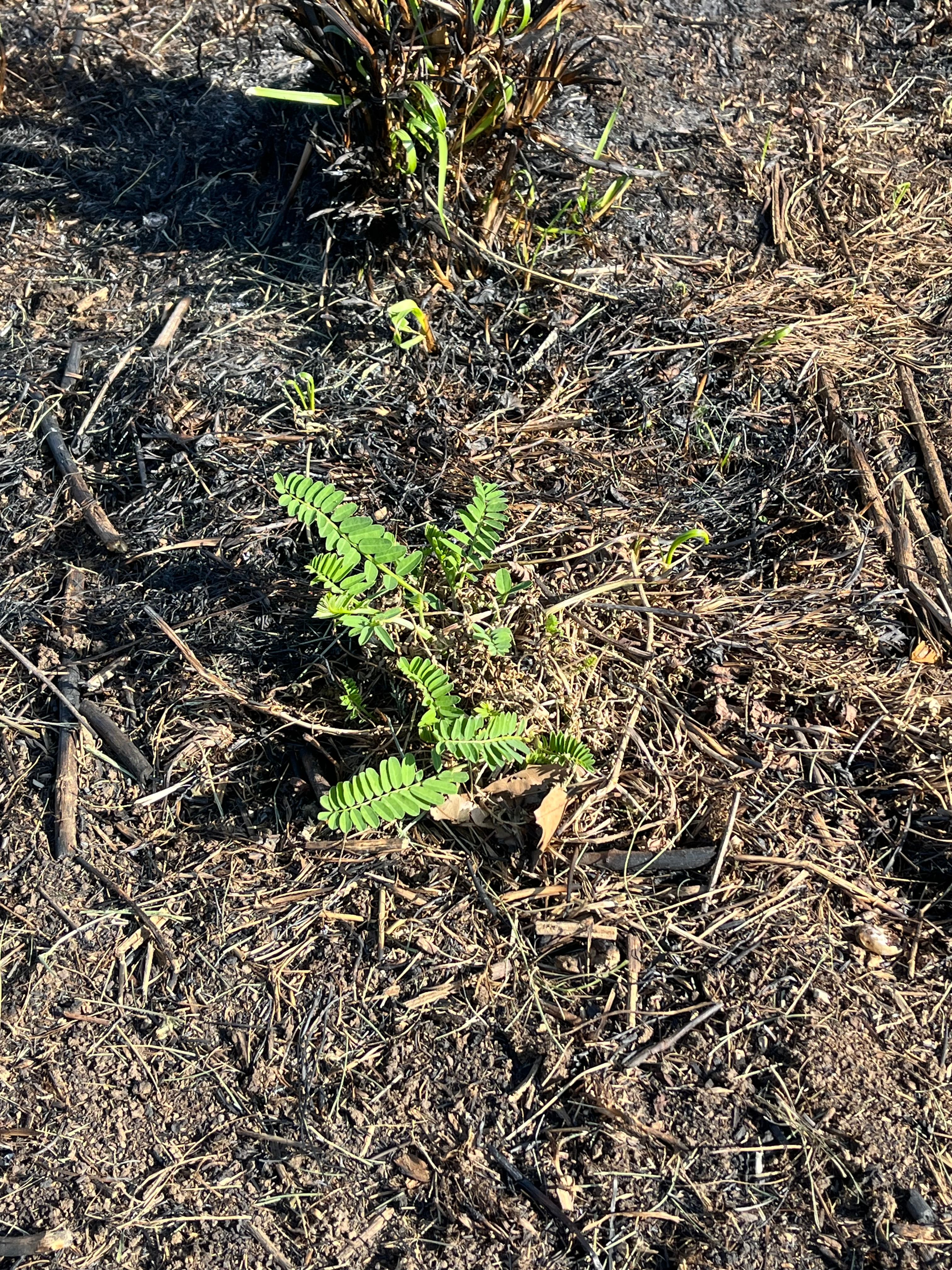
nonnative crownvetch growing in burned field
Goat update
So far, the goats have chowed down on autumn olive, invasive honeysuckle, and multiflora rose, and I continue to target those plants as we move into poison ivy season. Poison ivy is growing prolifically in the field now; there are places where it’s already a couple of feet tall. In the past, when I let it grow, it was eventually dwarfed by bramble, but still posed a hazard whenever we needed to venture into the meadow. Guess who loves to eat poison ivy? Goats, of course! Now, I realize this is a native plant, but believe me when I tell you, we will have plenty of it left for wildlife, even if the goats eat some.
In case anyone is concerned about the native plants the goats might be eating, I’m not putting them in fields where that would be a big concern. And, the dominant native plants here are plants they don’t care to eat (like milkweed and crownbeard). One of them was seen eating a new dogbane shoot, and this is supposed to be bad (like the other two plants, extremely toxic). The goat was fine.
You can see in the photo below that the goats have done their job.
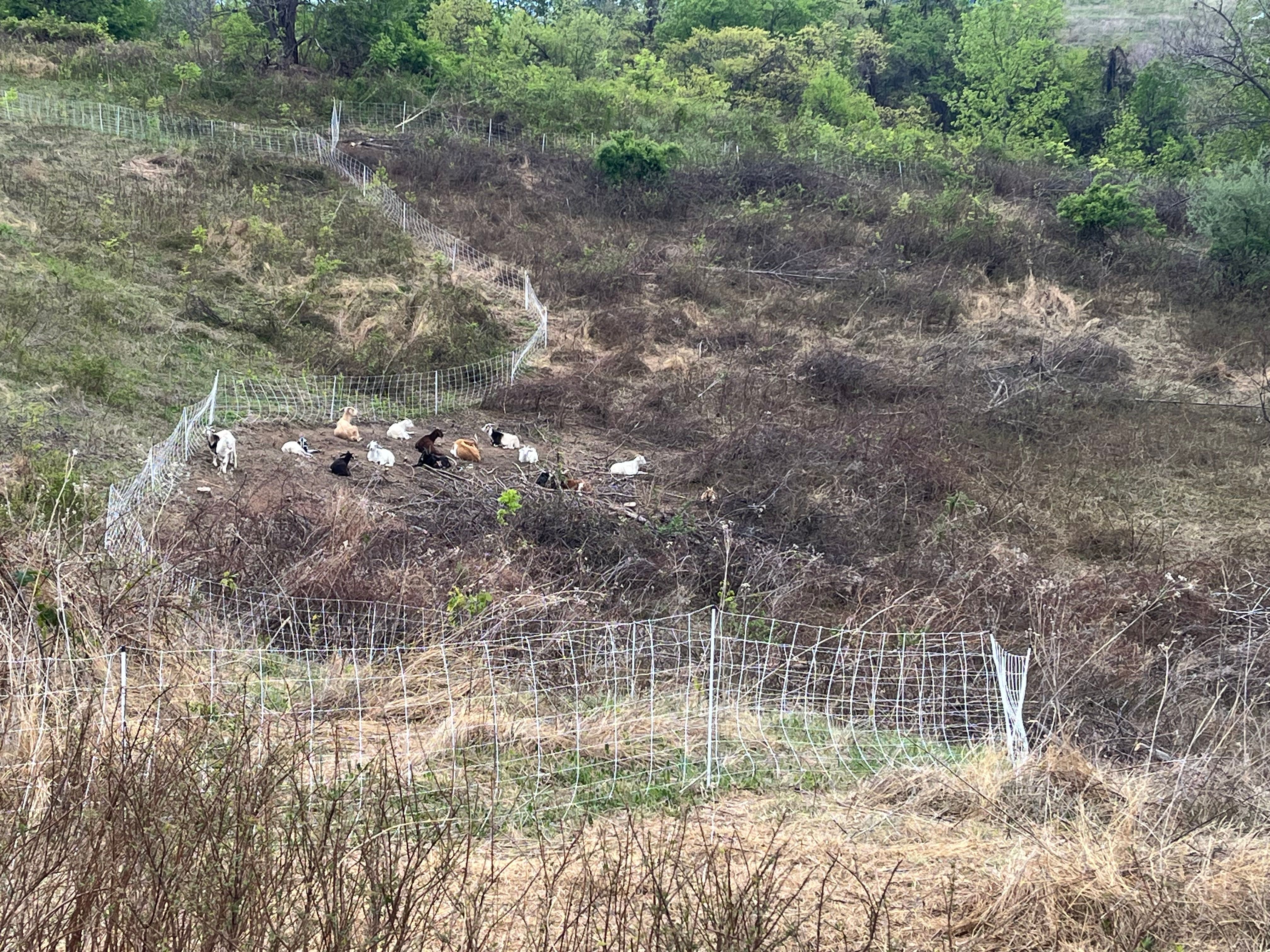
Goats resting after a satisfying meal of invasive honeysuckle.
I expect that within days I’ll starting seeing mile-a-minute growing in the fields. That vine is one of my primary targets. It climbs over bramble and tall crownbeard and smothers everything. In the fields where the goats have been dining, the mile-a-minute will be far more visible when it begins to come up—and they will eat that, too.
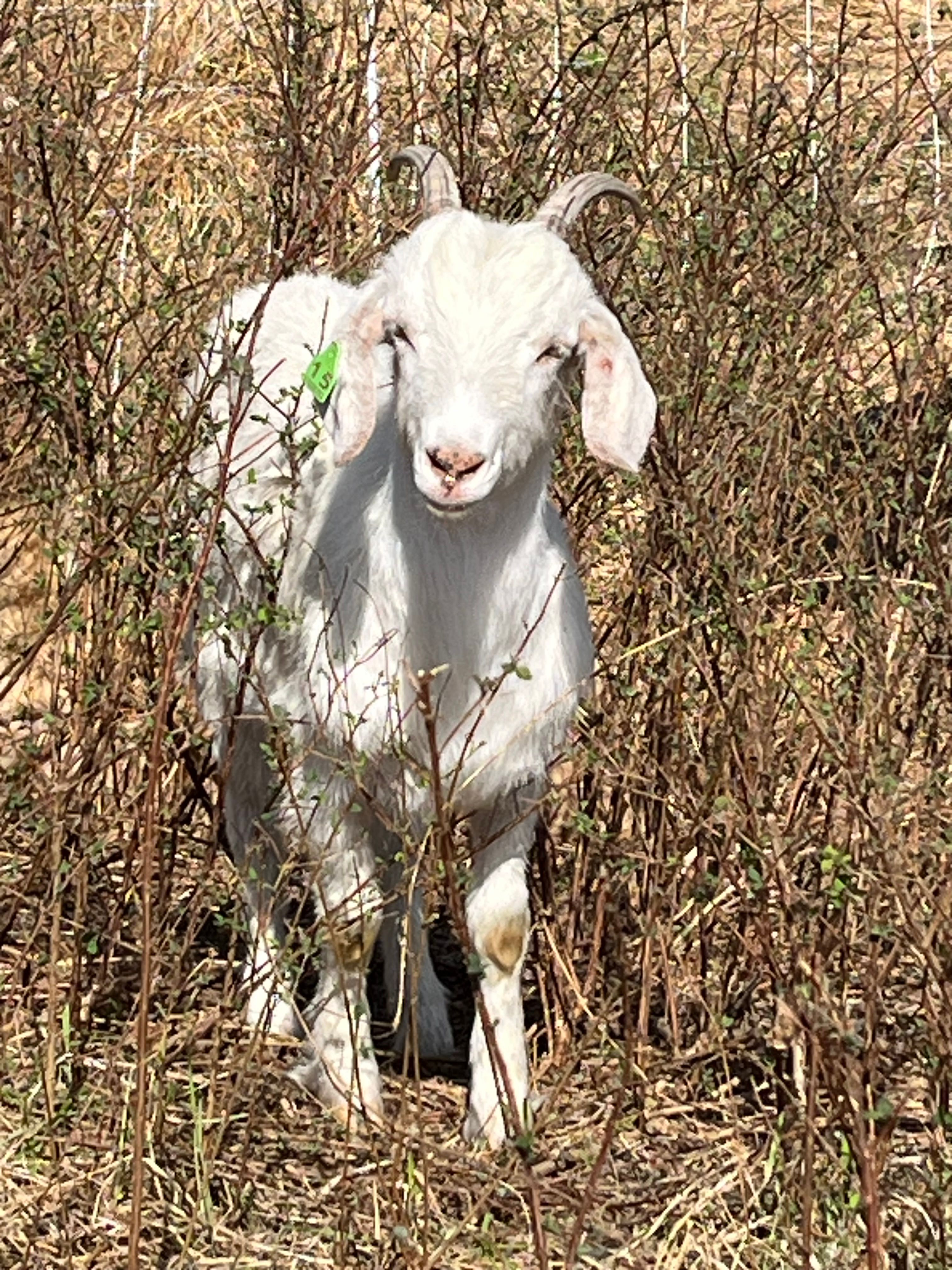
Obligatory cute goat photo (Adorbs, right?)
Signs of Life
How does your garden grow?
Last spring, we planted native plants around the house. Unlike the meadows, this area, which was excavated for building, was not producing diverse native plant growth. Now, a year later, these plants are beginning to flower. Those currently in bloom include big leaf lupine, a couple of types of bluestar, blue wild indigo, and foxglove beardtongue.
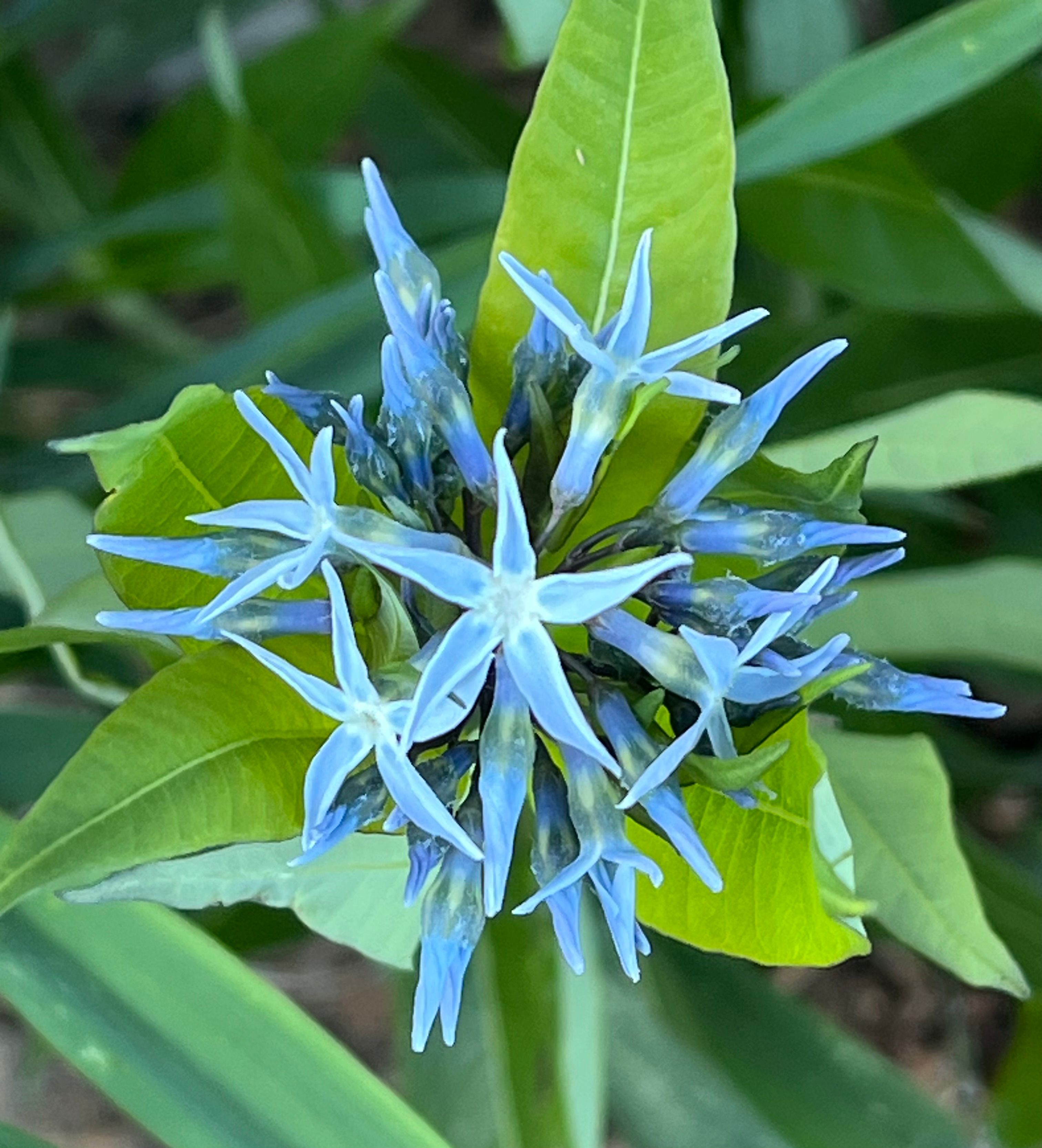
Eastern bluestar (amsonia)
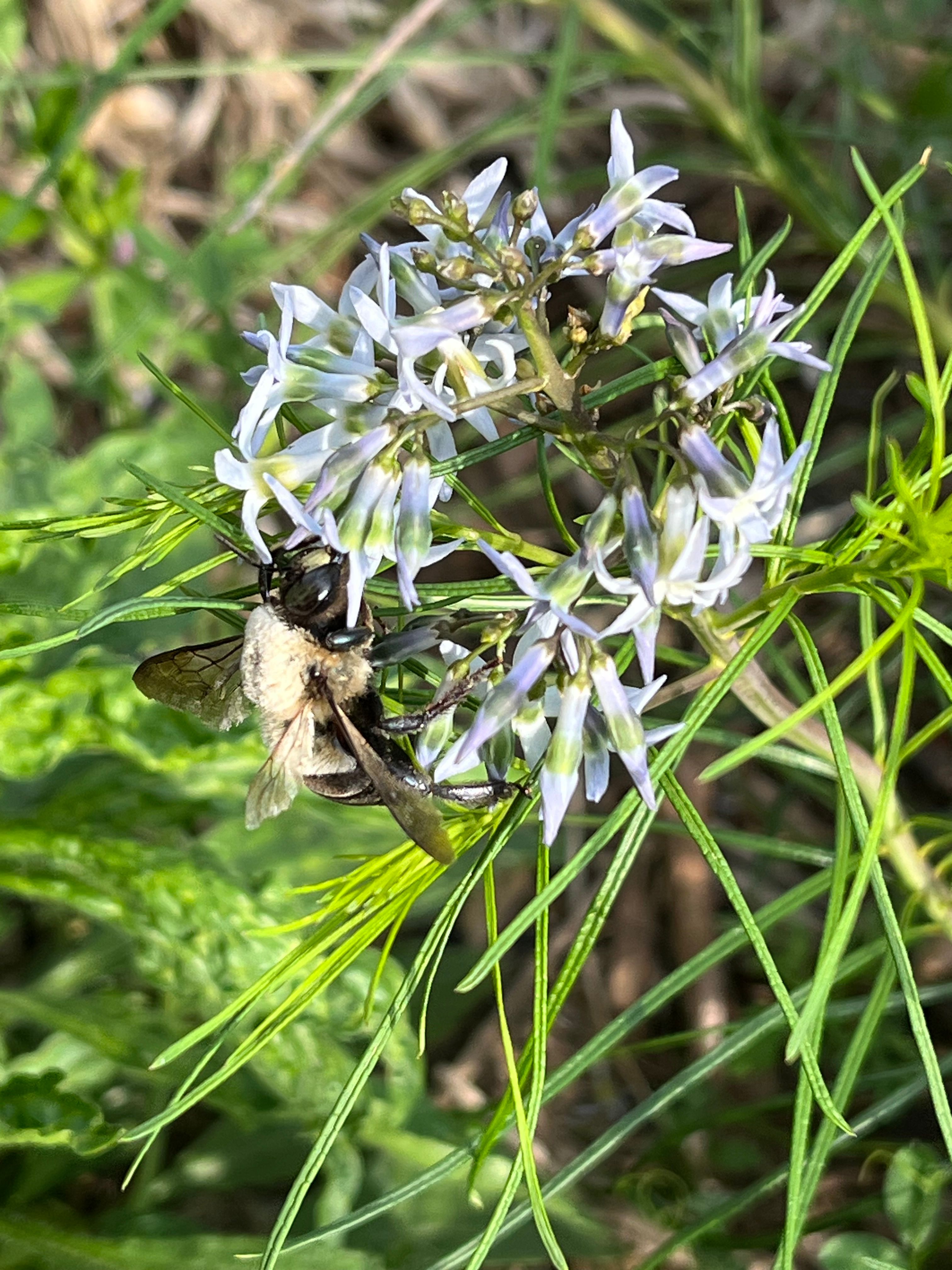
Another variety of bluestar—either threadleaf or fringed—any guesses?
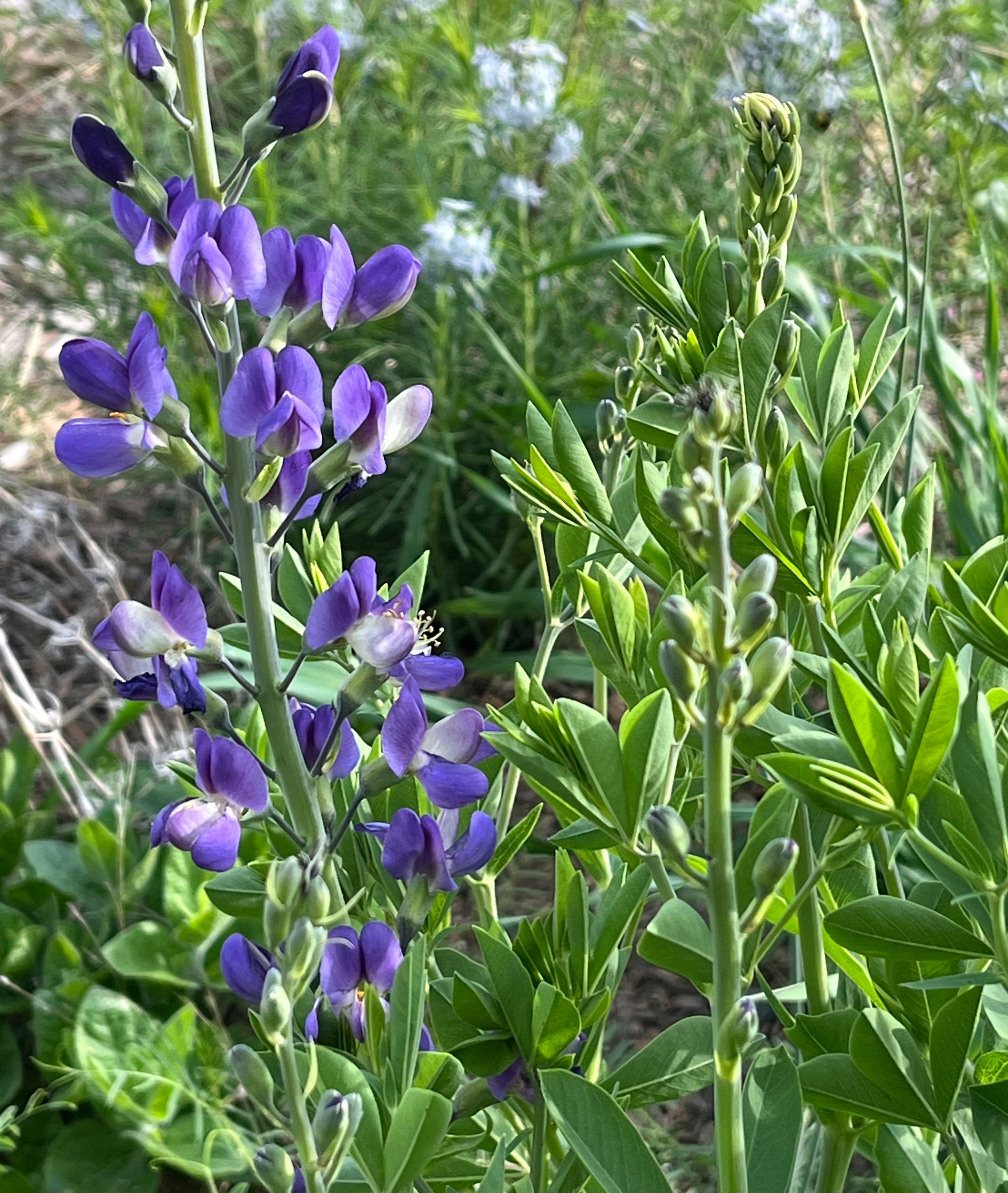
Blue wild indigo (baptisia)
Birds on the mountain
Like last year, the bluebirds have been busy here, inside and outside the boxes we installed. What’s happening inside the boxes? One nest has already fledged, two nests are getting ready to fledge, and in another, I got a peek at new hatchlings!
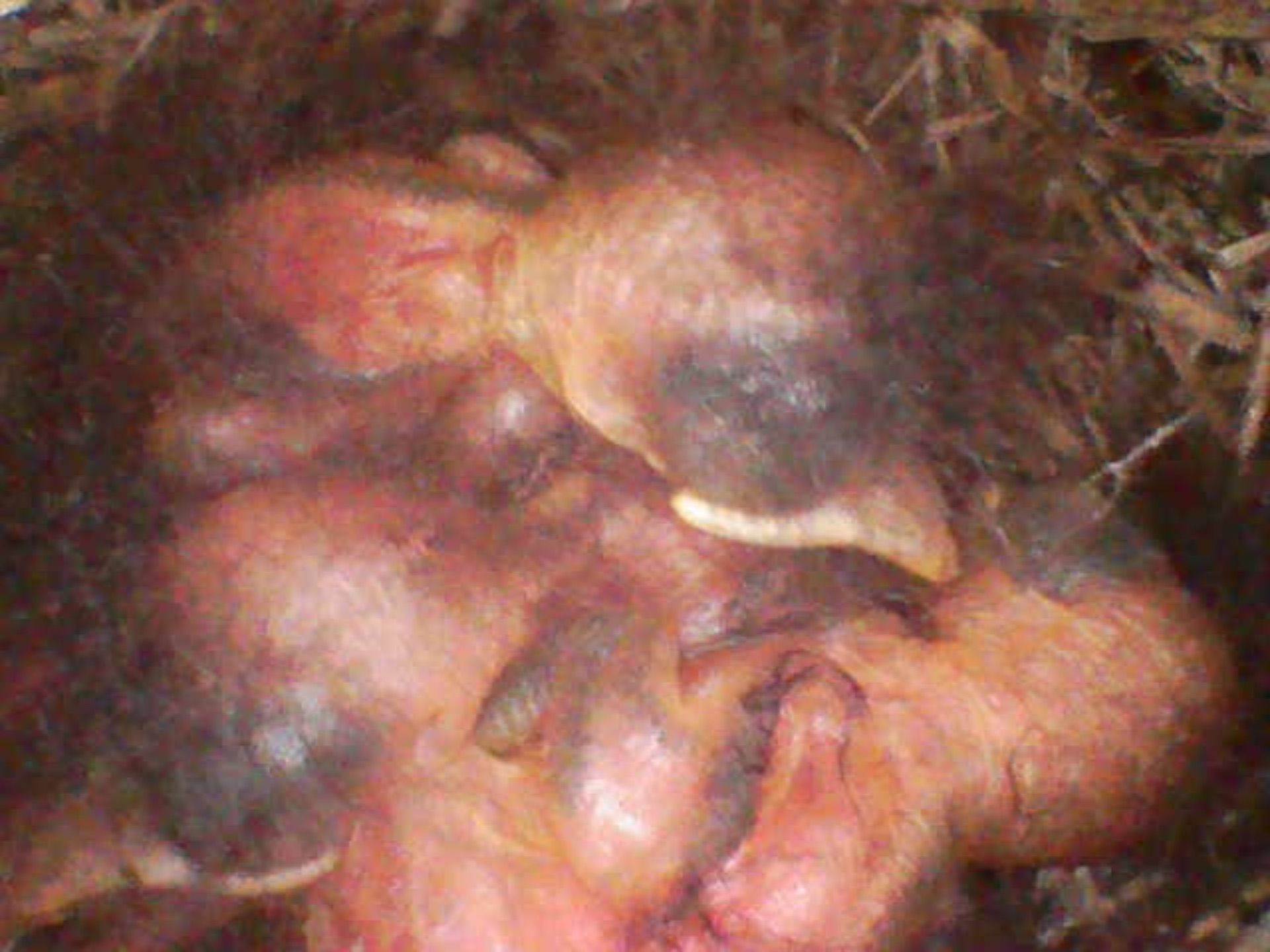
bluebird hatchlings in nest box
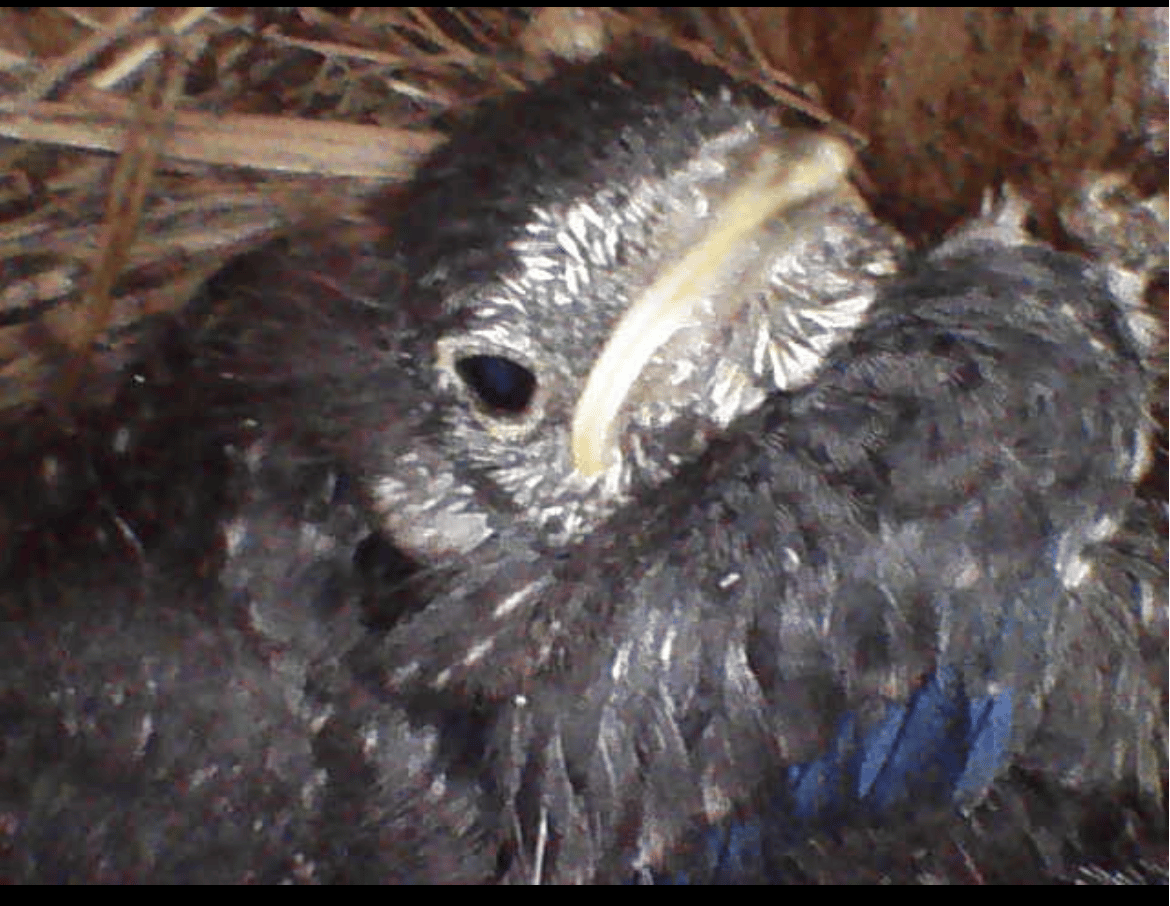
Why do baby birds always look so annoyed? (Could it be because I’m sticking a tiny camera through the entrance to their nest box?)
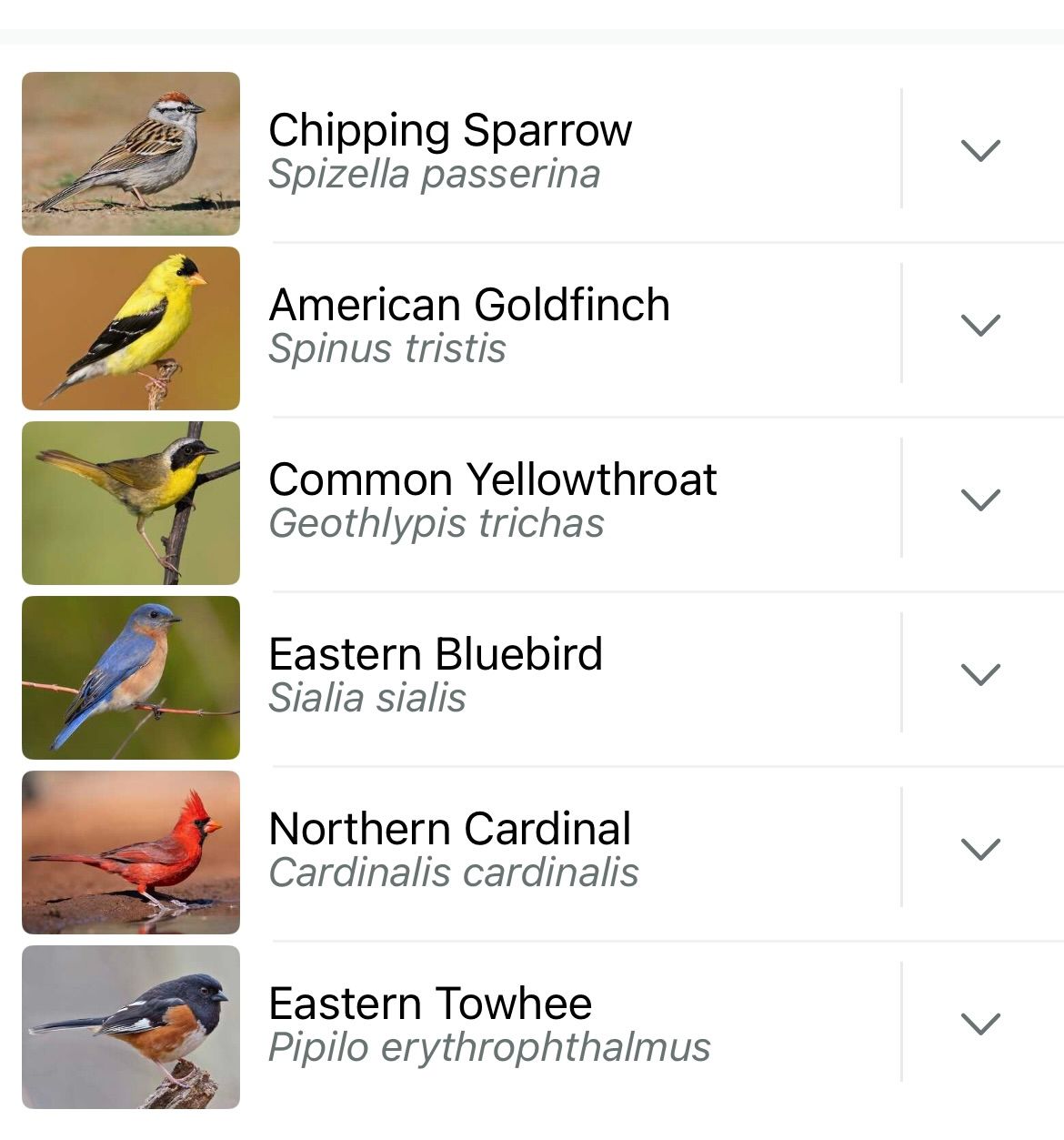
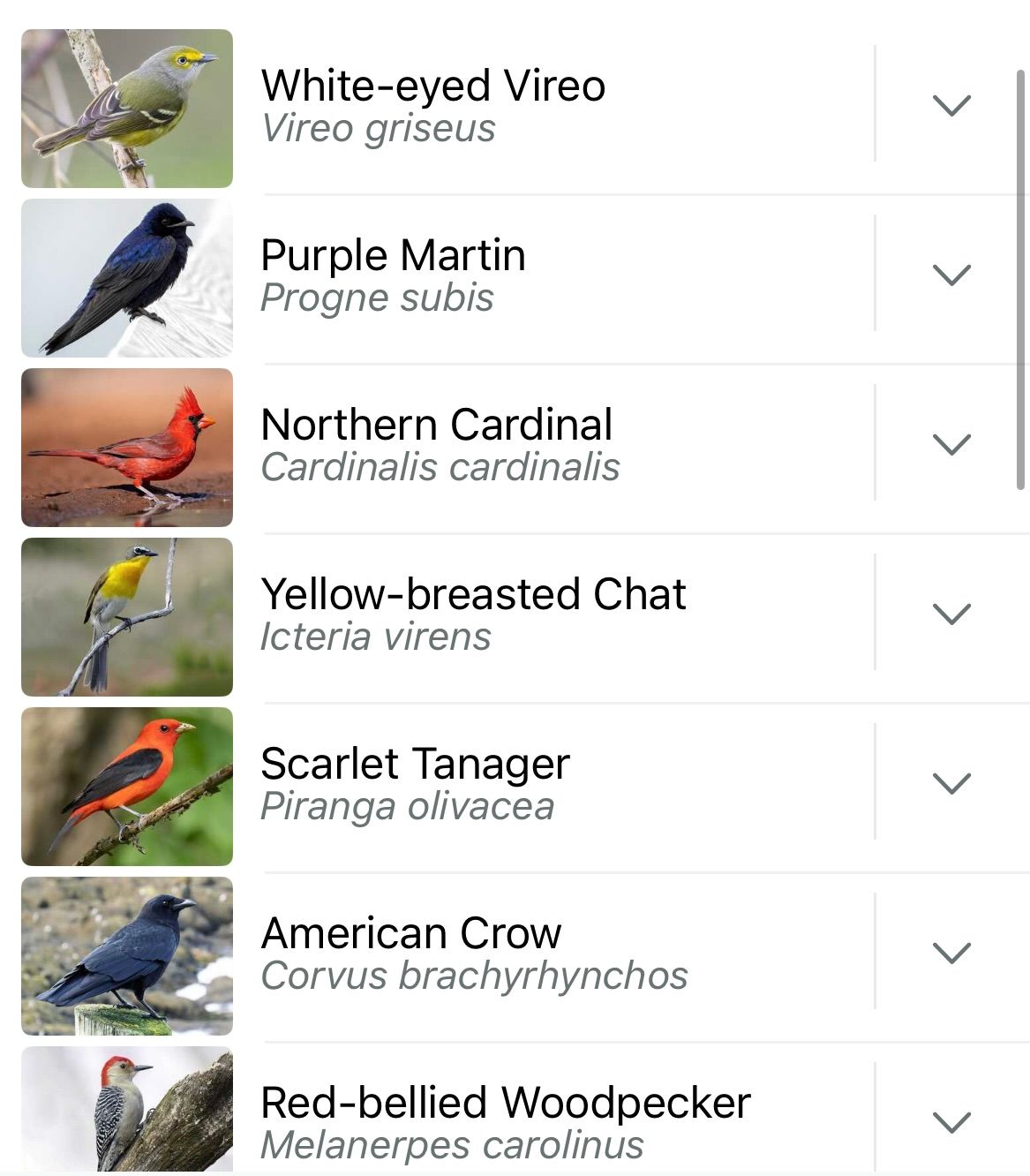
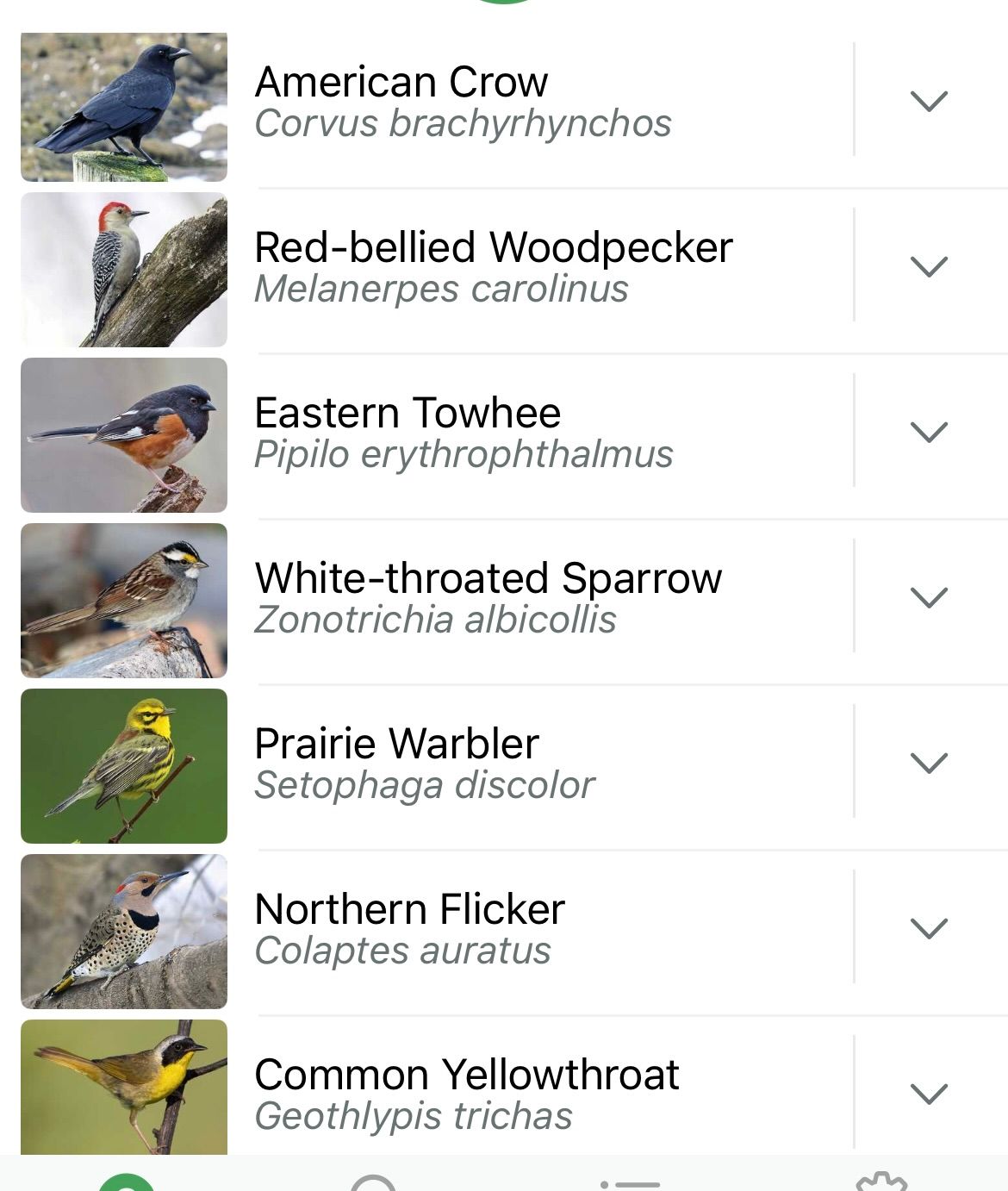
Meanwhile, the migrating birds have returned, and the mainstays are making their presence known, too. Here’s what Merlin, Cornell’s fantastic bird app, detected while I wandered around different parts of the meadow yesterday. I’ll be diving in to talk about a few of these species in detail in the months to come.
Recommended reading
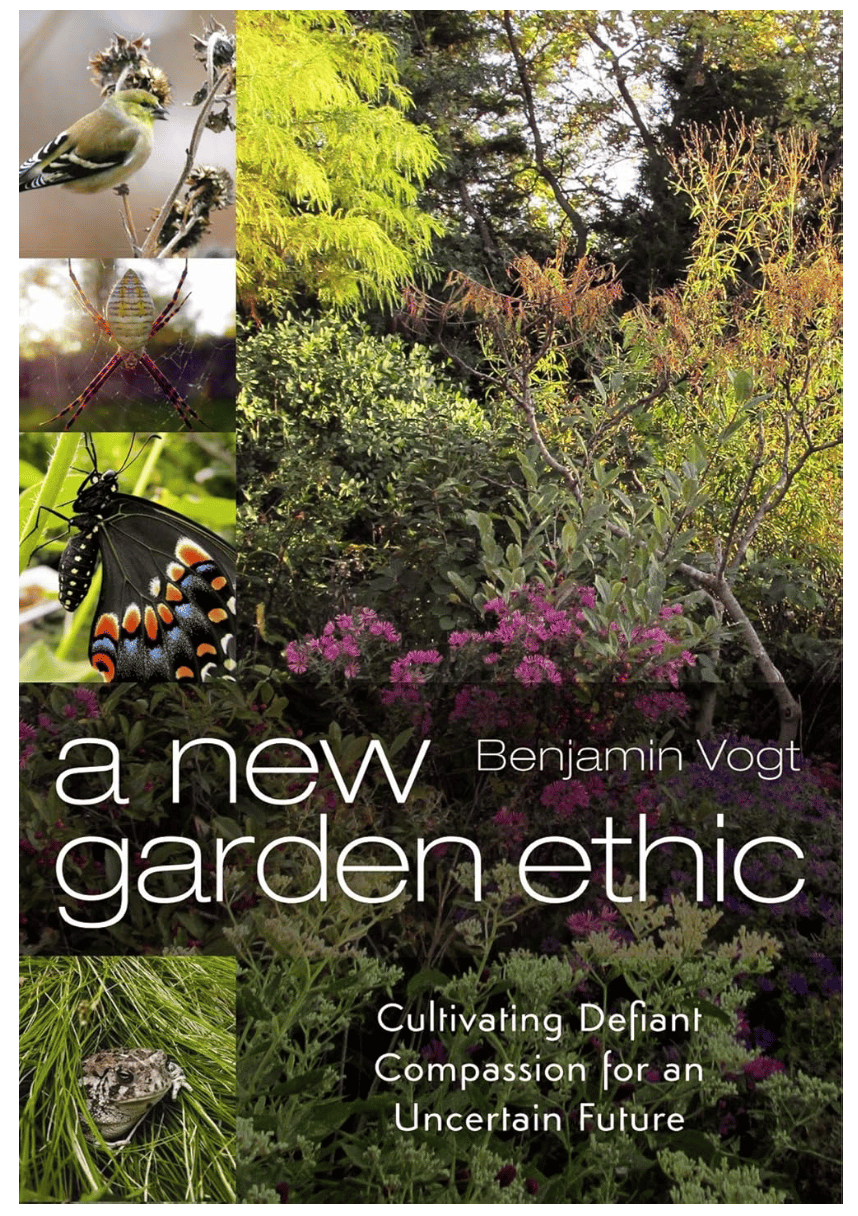
Benjamin Vogt’s book A New Garden Ethic: Cultivating Defiant Compassion for an Uncertain Future was first published in 2017, but still very relevant. It’s a manifesto of sorts that discusses why gardening with native plants in urban and suburban places is critically important for biodiversity, for the health of the planet, and for our own health.
A review by British garden designer Noel Kingsbury in Gardens Illustrated called it "A passionate and eloquent [...] exploration of the ethical case for native plants and its philosophical implications."
Don’t forget to tell me about your favorite nature-related book or podcast, and I’ll share it in a future newsletter.
Book news
In late March, I traveled to Harvard, Illinois, for the annual celebration of The Land Conservancy of McHenry County (TLC). It was a fun and inspiring event, attended by around 200 people. I got to hear about the important and difficult work the group is doing to conserve land and help with ecological restoration, including managing invasive plants—right down my alley. While I was in town, I had a chance to spend the night at The Blue Farm, a lovely 80-acre farm that includes prairie and wetlands, all under a conservation easement administered by TLC. The hosts are warm and welcoming—and there are goats!
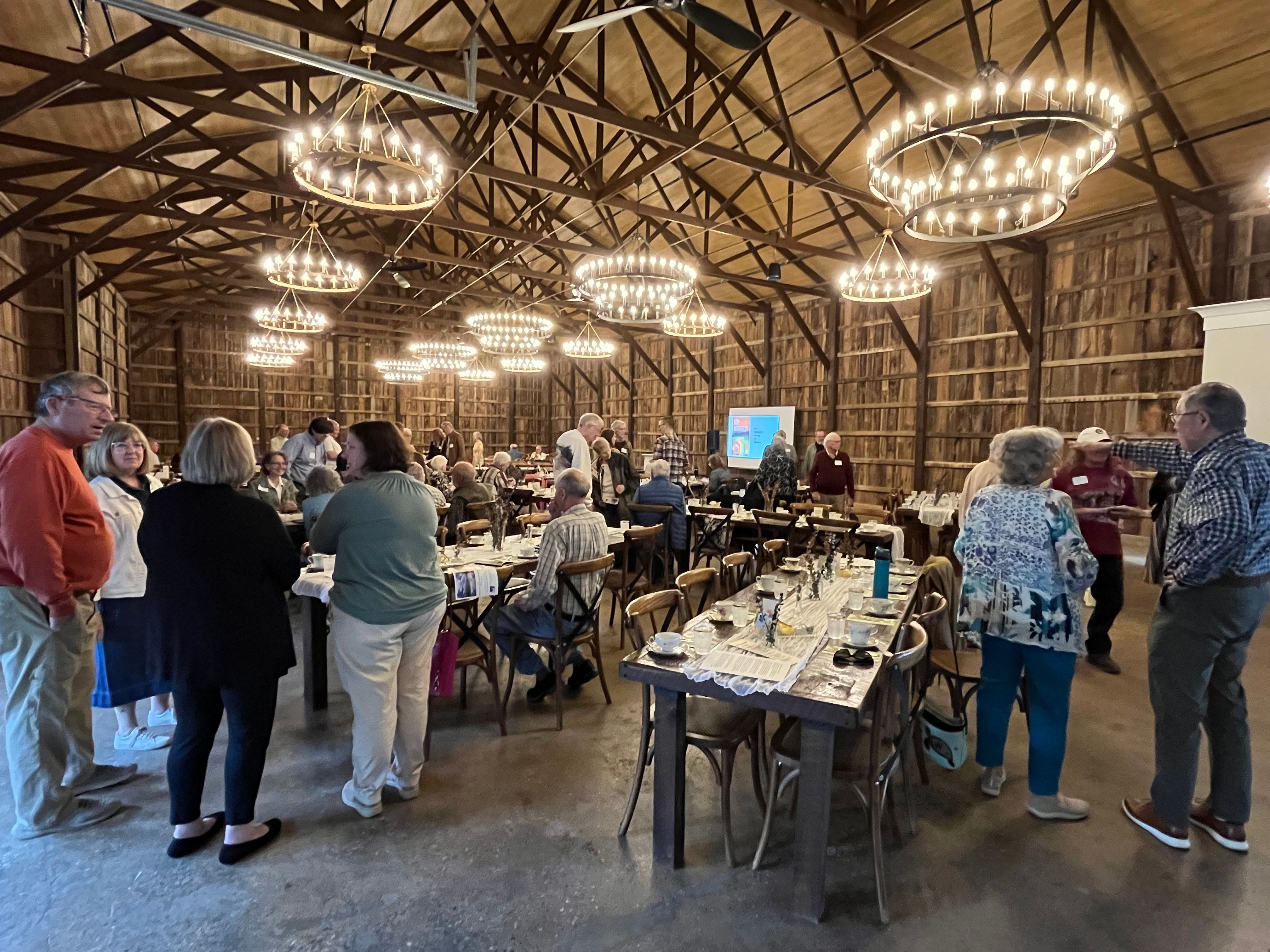
the banquet hall before my TLC talk
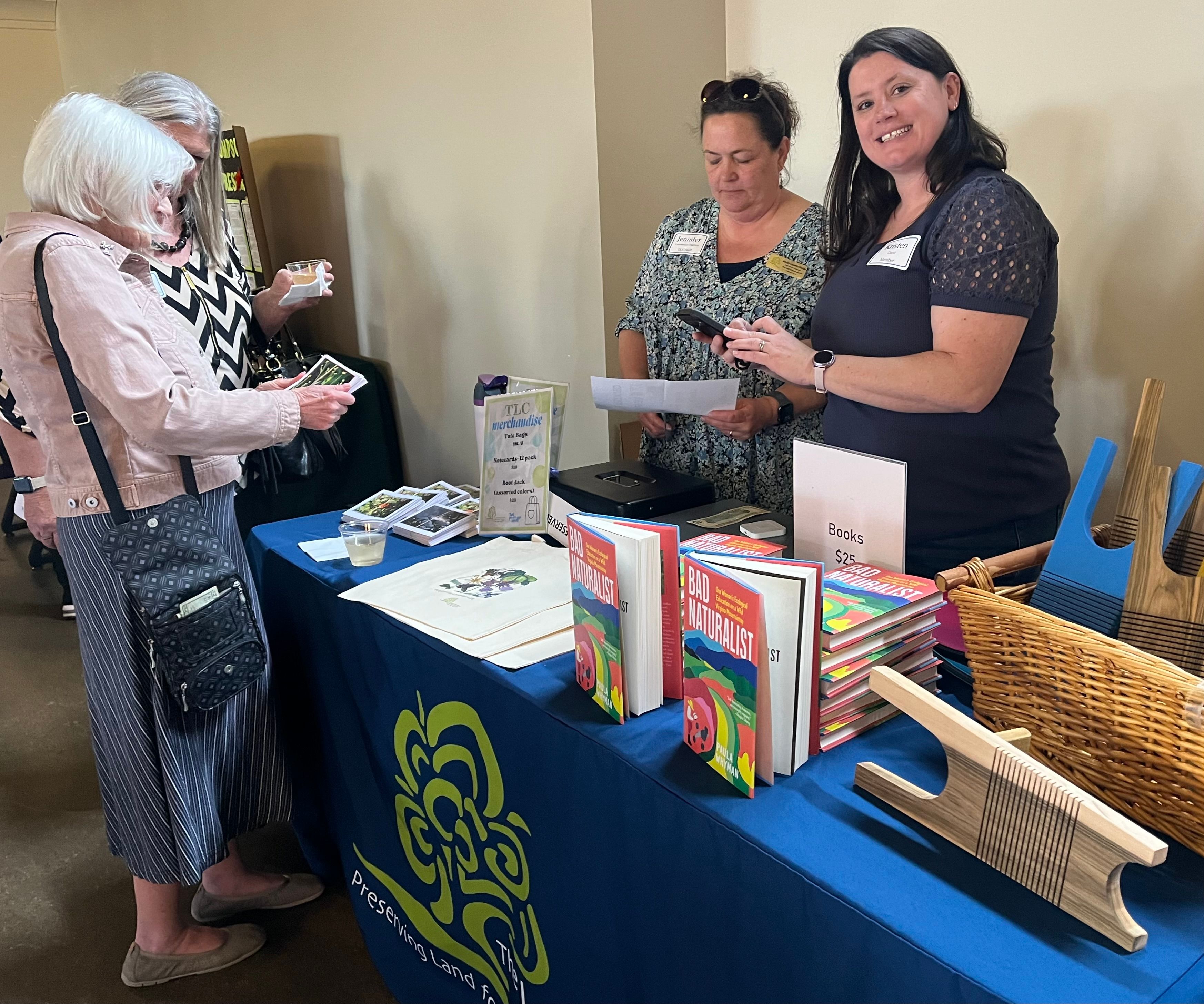
Bad Naturalist for sale at TLC event
The other day, I met with the book club of the Master Gardeners of Northern Virginia, the Arlington/Alexandria unit of Virginia Cooperative Extension, for a fun, lively remote conversation. (I love meeting readers, and I’m happy to attend book clubs remotely, schedule-permitting!)
Now, I’m taking most of the summer off from traveling for book events (have to write that next book sometime!!). Look for announcements about future events as fall approaches.
Check my website event page, or my Instagram or Bluesky feeds for details about events, and for more interviews, podcasts, and features. If you don’t see your city or town on this list, please reach out, and I’ll see what I can do to get there!
The paperback is coming!
Just a reminder that you can preorder the paperback edition of Bad Naturalist now, and it will be available on August 11!
Bad Naturalist is available wherever books are sold in stores and online, currently in hardcover, e-book, and audiobook formats. You can sample the audiobook here.
A special request
If you read the book in any format (and if you enjoyed it!), please post a review on the Amazon book page—it helps!
Tell me where you are and what you see this month in a park near where you live, or in your own yard or window box. Send me a photo if you like.
Featured photo
The featured photo shows two volunteers in full safety gear monitoring the burn in the meadow, with smoke billowing up and a glimpse of orange flames.
The Official Mountain Poodle
Cleo welcomes the return of Rabbit Season. I am trying to train her not to throw herself at the window whenever she sees one. So far, this is working…sort of… Now I just have to stop her from freaking out at wild turkeys. The good news is, when she’s not guarding her territory against critters, she’s pretty laid back.
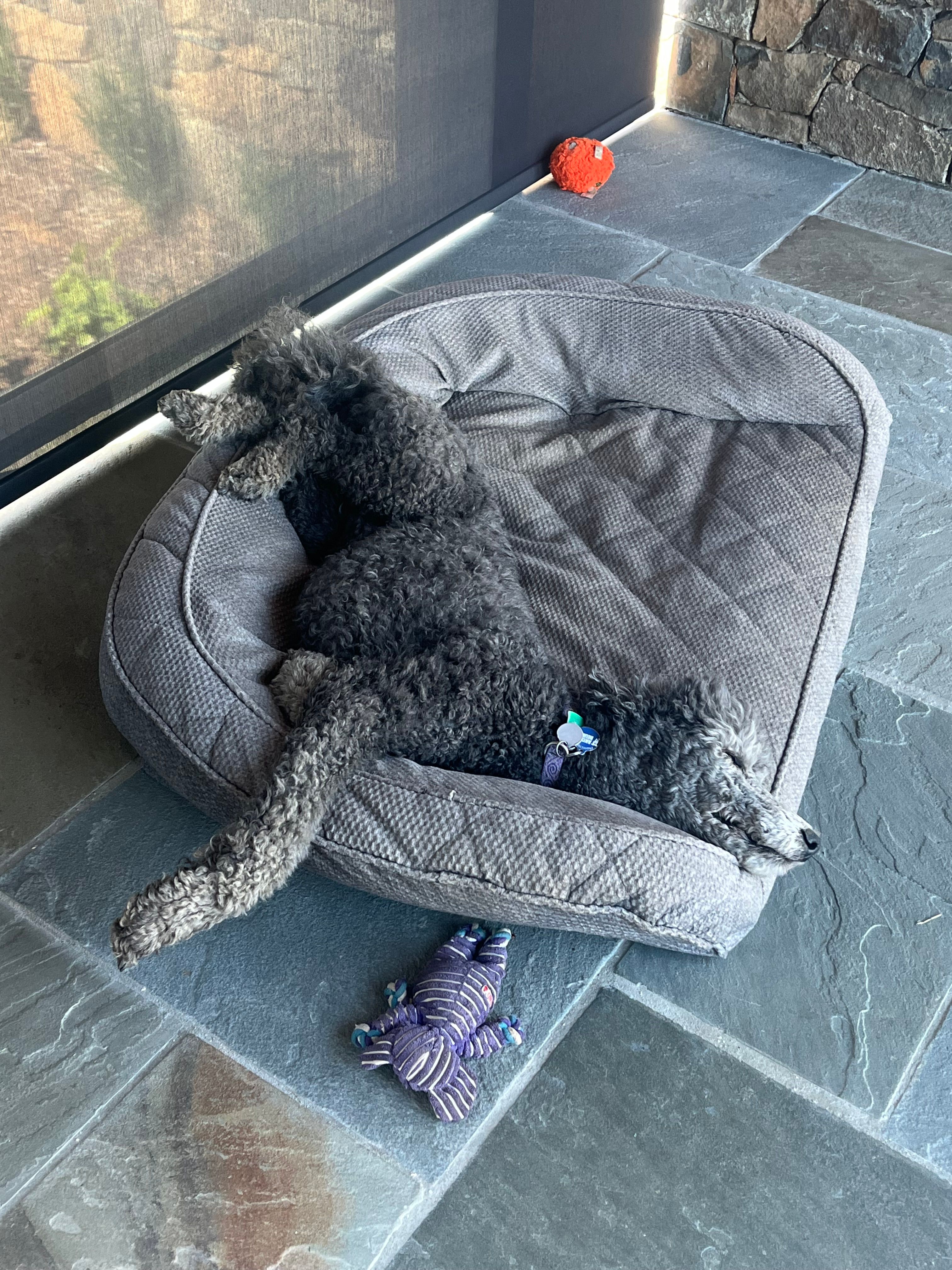
Now’s a good time to subscribe for more mountain discoveries, book news, and the requisite poodle photos.
Thanks for joining me on the mountain!
Until next month—
Paula W.
Bad Naturalist: One Woman’s Ecological Education on a Wild Virginia Mountaintop
Now available in hardcover, audiobook, and e-book everywhere books are sold!
You can also…
Reply