- Bad Naturalist Newsletter
- Posts
- March Madness
March Madness
Mountain-Style

Paula Whyman
March 30, 2026
Geek out with me about critters and plants on a mountaintop in Virginia. I’ll share what I’m learning as I try to bring native plants back on 200 acres of old farmland and tell stories from my encounters on the mountain.
Want to subscribe? (It’s free!)
Want to read it first? (I don’t blame you.)
In this issue
Field notes: Goats! Goats! Goats! (redux)
Signs of life: Bluebirds take no flack
Recommended reading
Book news: Paperback reveal!
The Official Mountain Poodle
I’ve written a book about what I’m doing and what I’m discovering here on the mountain…
BAD NATURALIST: One Woman’s Ecological Education on a Wild Virginia Mountaintop
Have I mentioned, BAD NATURALIST is a
Finalist for the Philip D. Reed Environmental Writing Award
Field Notes
Goats! Goats! Goats! Again!
Last fall, goats came to the mountain for a few weeks to munch on mile-a-minute vine. The results of that experiment were promising enough that I decided to bring goats back for a long stay. They arrived this weekend and started right in eating the ecologically harmful* plants that are currently greening up in the meadow. These goats are a combination of Kiko and Boer breeds; they’re on loan from a neighbor’s farm.
The idea is to move the herd frequently throughout the season as invasive plants begin to pop up in different parts of the meadow. Right now that means focusing on multiflora rose that lines the edges of the woods, Japanese honeysuckle snaking through the meadow and climbing over fences and up trees, and autumn olive popping up everywhere.

Multiflora rose on a hillside. Everything that’s green here right now is a noxious weed.
On Day 1, the goats stripped the bark on an autumn olive (see photo below), which will kill it. The bark must taste good; I’ve never tried it myself.
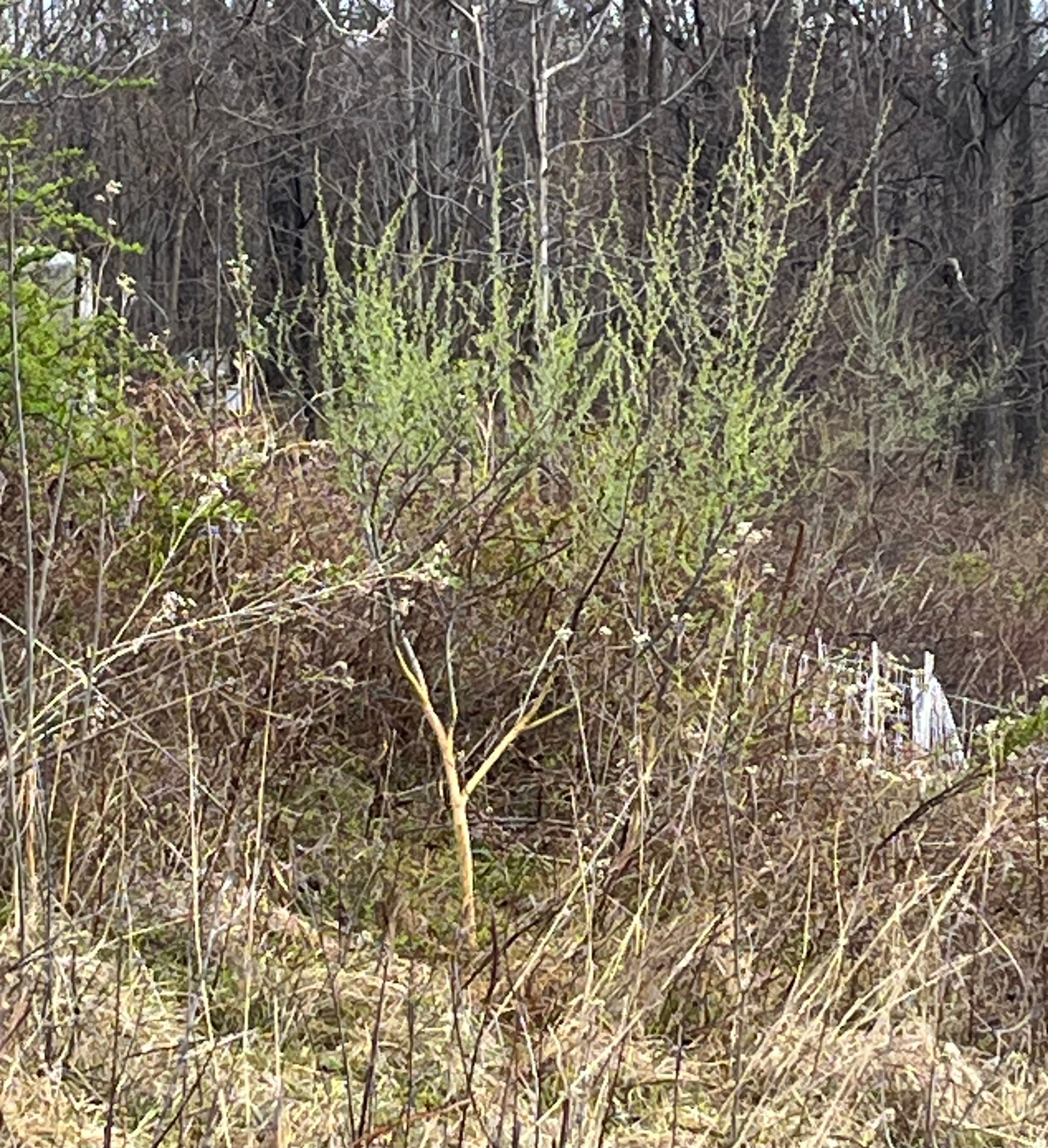
Autumn olive with stripped bark
The goats, being an introduced species themselves, seem to like introduced plants—which doesn’t mean they won’t eat native plants, they absolutely will, especially if there is not enough of the other tasty stuff around. They will, for instance, eat blackberry when it’s young and green, and I plan to encourage that, since there is so much bramble around here that it can be difficult to access the fields. But as a rule, I won’t put the goats in a field that consists primarily of native plants.
Also, did I mention that the goats are pretty cute?
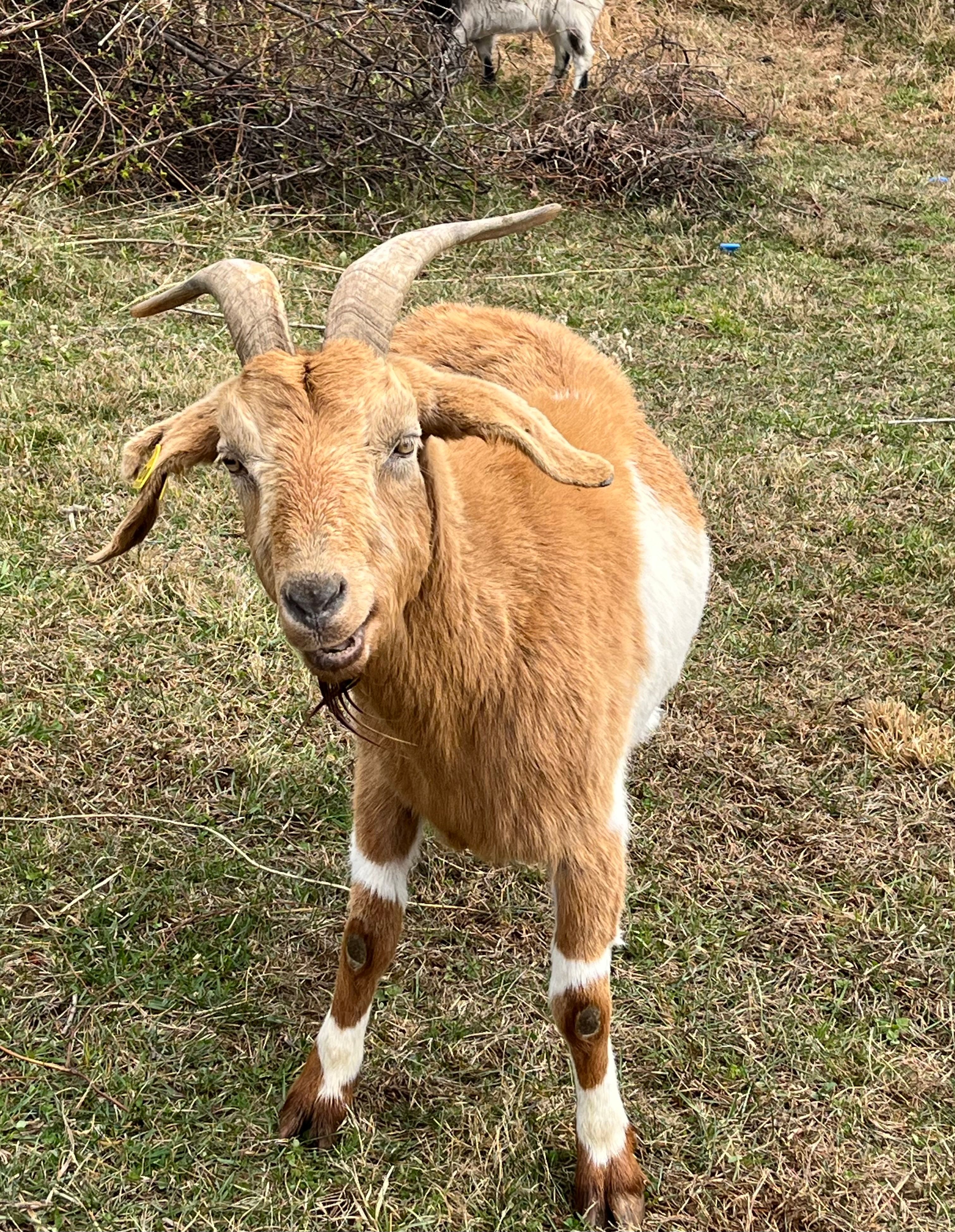
This girl likes to eavesdrop on the humans’ conversations. I wonder what she learned?

Eating honeysuckle

Cuteness

Climber
When will we ever burn?
You may recall that back in November, a firebreak was cut around a 9-acre field on the mountain. After a long wait through bad burn weather days (too windy, too foggy, too overcast, too dry, too wet), a good burn weather day came along in mid-March, and everything was set. I got my hopes way up! The burn staff arrived, and it looked like all systems were go. Then, at the last moment, there were equipment problems—and no burn. Now I’m hanging on to a shred of hope that there will be a good burn weather day before the end of April. After that, it will be too warm and humid, and I’ll be waiting for fall (again).
On the upside, in early March, I completed the Virginia Department of Forestry’s Certified Prescribed Burn Manager course. I learned a lot about weather conditions and their impact on fire and smoke distribution, which type of burn is best for which situation, and how different types of fuels (plants) impact fire behavior. I was stressed about the final exam, which took about 2 hours. When was the last time I had to take a test? I can’t remember. But I’m happy to report that I got an A on the final. (Will that count toward my average?) So, I’m now a Certified Prescribed Burn Manager. But before I’ll feel comfortable initiating and leading a burn on the mountain, I will need hands-on experience. Stay tuned for that…
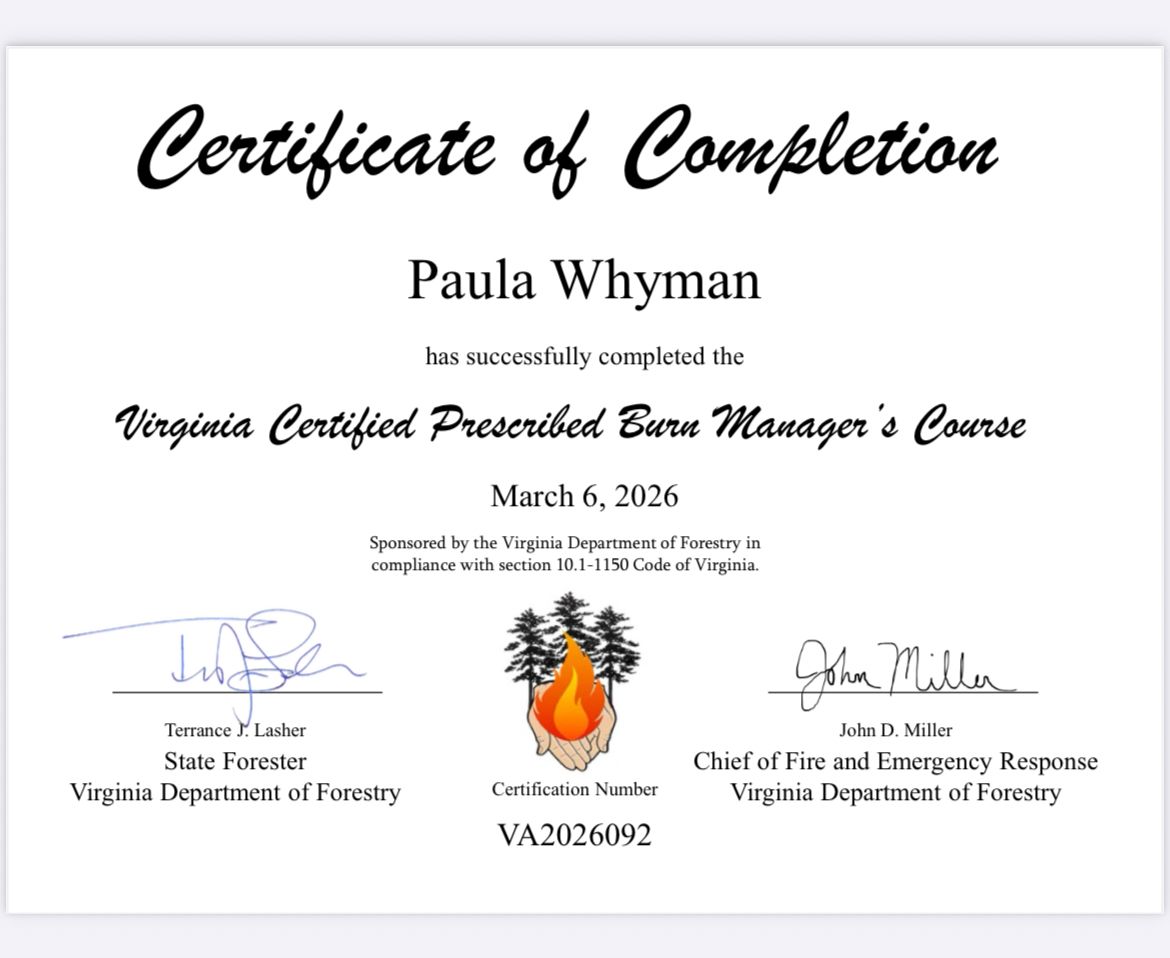
I passed!
With prescribed burning a less-than-regular event here, the goats may be even more critical to controlling those ecologically harmful* plants in the meadows.
*I gave a talk as part of the Shenandoah Valley Plant Symposium earlier this month, and another speaker that day, Ulrich Lorimer, director of the Native Plant Trust, referred to invasive plants as “ecologically harmful plants.” I like that the meaning of that description is perfectly clear.
Signs of Life
Pecked to death by bluebirds
Okay, that’s a bit of hyperbole. But I learned recently that bluebirds are not shy, retiring types. For the past few weeks, I’ve been watching them fly back and forth between trees and our rooftop and boulders, presumably deciding where to nest. Like any customer searching for real estate, they like to check a place out first. I decided to double-check that the bluebird nest boxes in the meadow were still in good shape and not host to a mess left by winter visitors. I brought along my trusty endoscope (yes, the one doctors use to look inside various orifices…well, not the exact same one), which is perfect for snaking through the small hole in the front of the nest box. The scope connects with my phone via a USB, and then I can view the interior, and I can even take a so-so photo. (Your doctor can take a better photo. I hope.) When I passed the endoscope through the opening in one of the boxes, there was a clatter inside and something knocked against the scope, rattling it repeatedly. It was clear that something—someone—was alternately grabbing at and pecking it. As soon as I removed the scope, a bluebird stuck her head out of the hole and glared at me in indignation. (You don’t want to see an indignant bluebird.) I hope that my intrusive behavior didn’t dissuade her from nesting there. At another box, a pair of bluebirds was already in the midst of nest-building, so I steered clear. A promising start to the season.
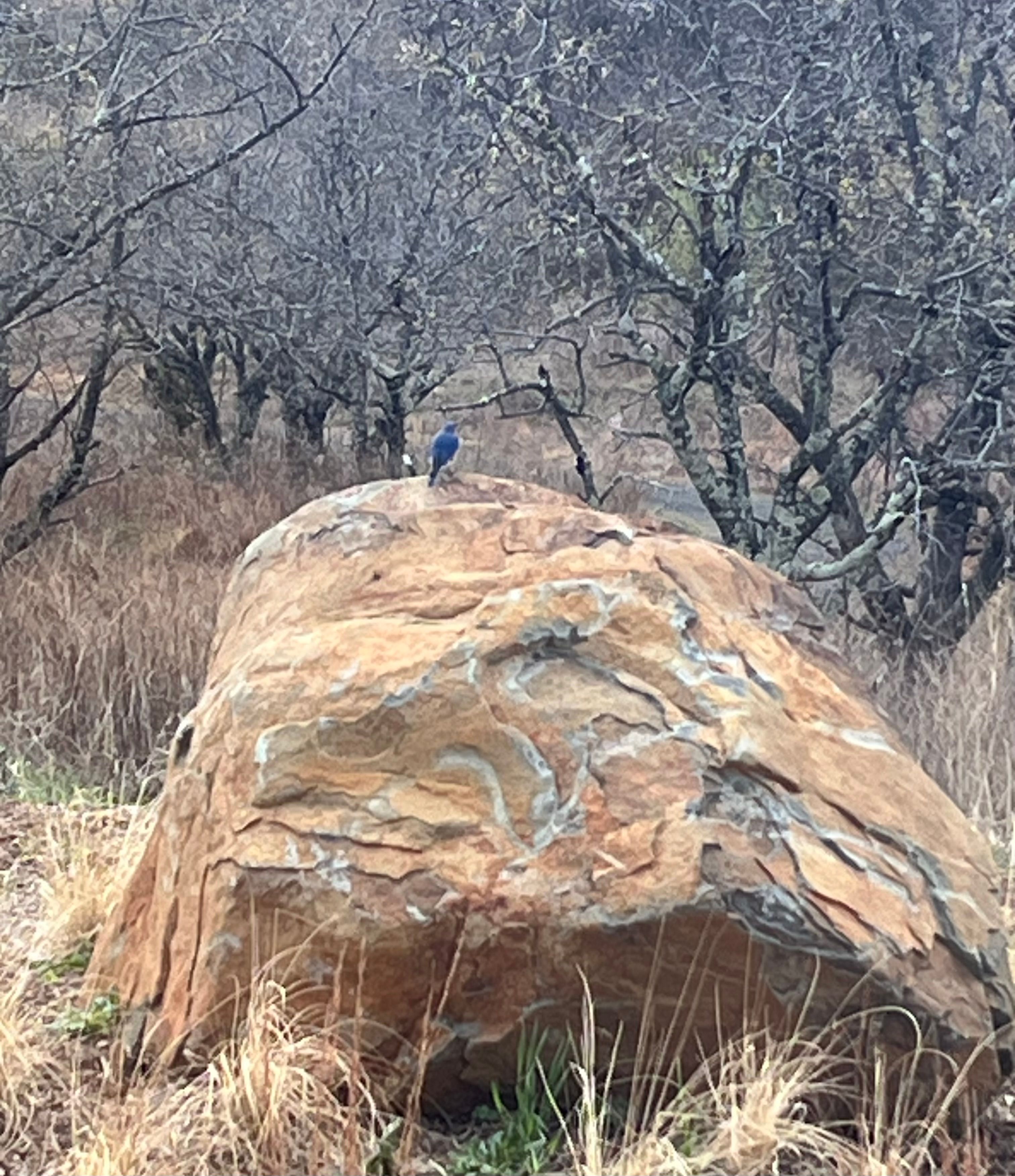
Bluebird on boulder

Blurry photo of bluebird checking out a nest box (taken with endoscope)
Not so eensy-weensy
The first black widow spider of the season was hiding in the shelter of an exterior stairwell. She is the largest black widow I’ve ever seen, with an abdomen as big around as my thumb. A reminder that last summer, we spotted one of these spiders eating a spotted lanternfly. I have high hopes for this summer.

Southern black widow
Recommended reading
Catherine Coleman-Flowers is the winner in the book category of the Southern Environmental Law Center’s 2026 Philip D. Reed Environmental Writing Award for her book of essays Holy Ground: On Activism, Environmental Justice, and Finding Hope.
About the winning book, the SELC says that “in Holy Ground, Flowers shares an inspiring collection of essays that are deeply personal, with an urgent message. Drawing from a lifetime of organizing and advocacy, Flowers frames the defining challenges of our time, from climate change to rural poverty, through the lived experiences of the communities most often left behind.”

Don’t forget to tell me about your favorite nature-related book or podcast, and I’ll share it in a future newsletter.
Book news
Big news! The paperback edition of BAD NATURALIST is coming in August!
Can I get a drum roll, please? Here’s the new cover!
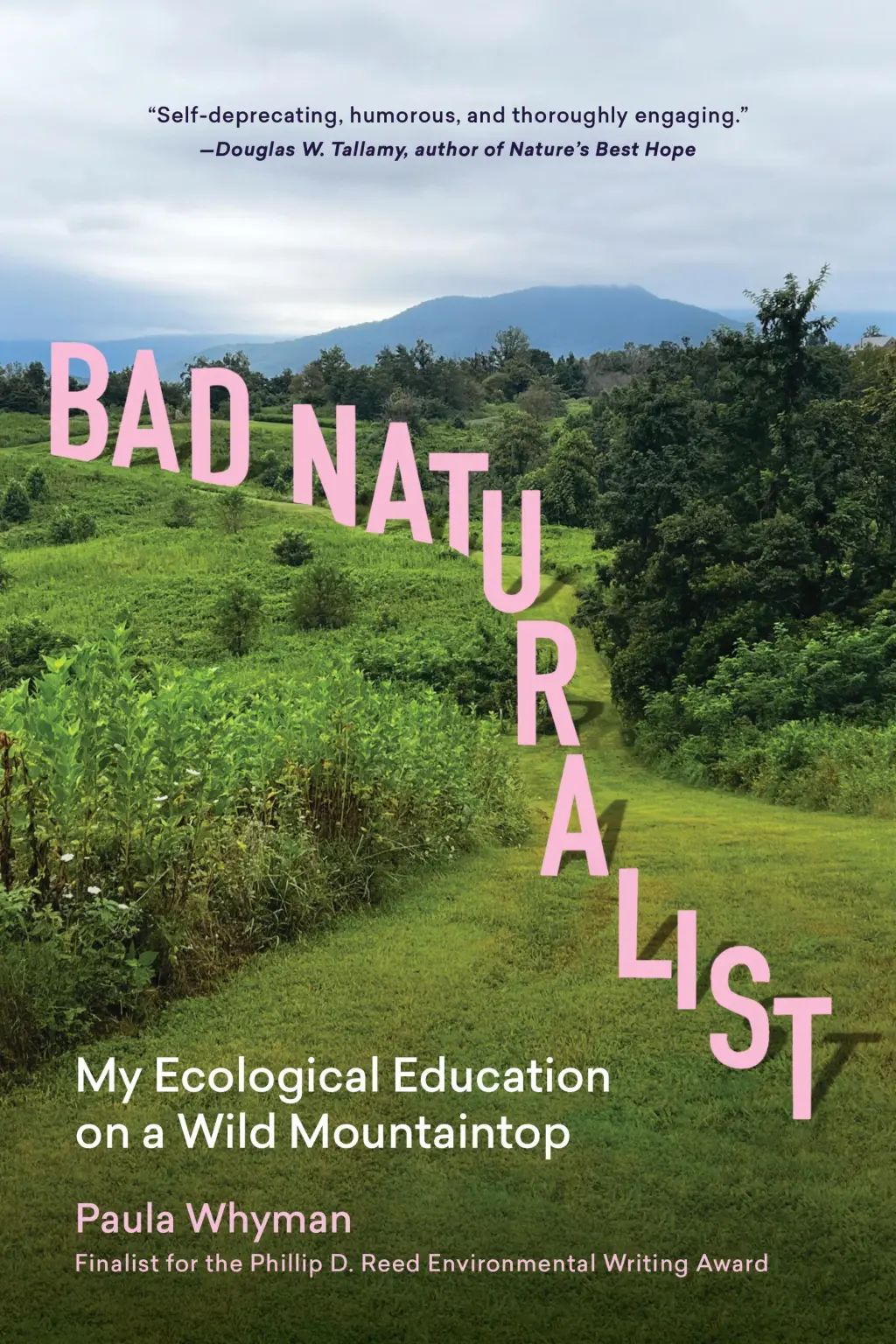
As is often the case, the paperback edition will have a different cover than the hardcover edition of the book. This time, the cover features a scene from the meadow in summer.
You can preorder the paperback now, and it will be available on August 11!
Seen on my travels…
Earlier this month, before my talk at Wing Haven in Charlotte, NC, I had a chance to explore the jewel-like gardens:

Wandering at Wing Haven
Upcoming events
Here’s where I’ll be in April:
The Land Conservancy of McHenry County, Annual celebration. Woodstock, Illinois. Sunday, April 12, 2026. 2-5pm. Registration required.
Check my website event page, or my Instagram or Bluesky feeds for details about events, and for more interviews, podcasts, and features. If you don’t see your city or town on this list, please reach out, and I’ll see what I can do to get there!
Bad Naturalist is available wherever books are sold in stores and online, in hardcover, e-book, and audiobook formats. You can sample the audiobook here.
A special request
If you read the book in any format (and if you enjoyed it!), please post a review on the Amazon book page—it helps!
Tell me where you are and what you see this month in a park near where you live, or in your own yard or window box. Send me a photo if you like.
Featured photo
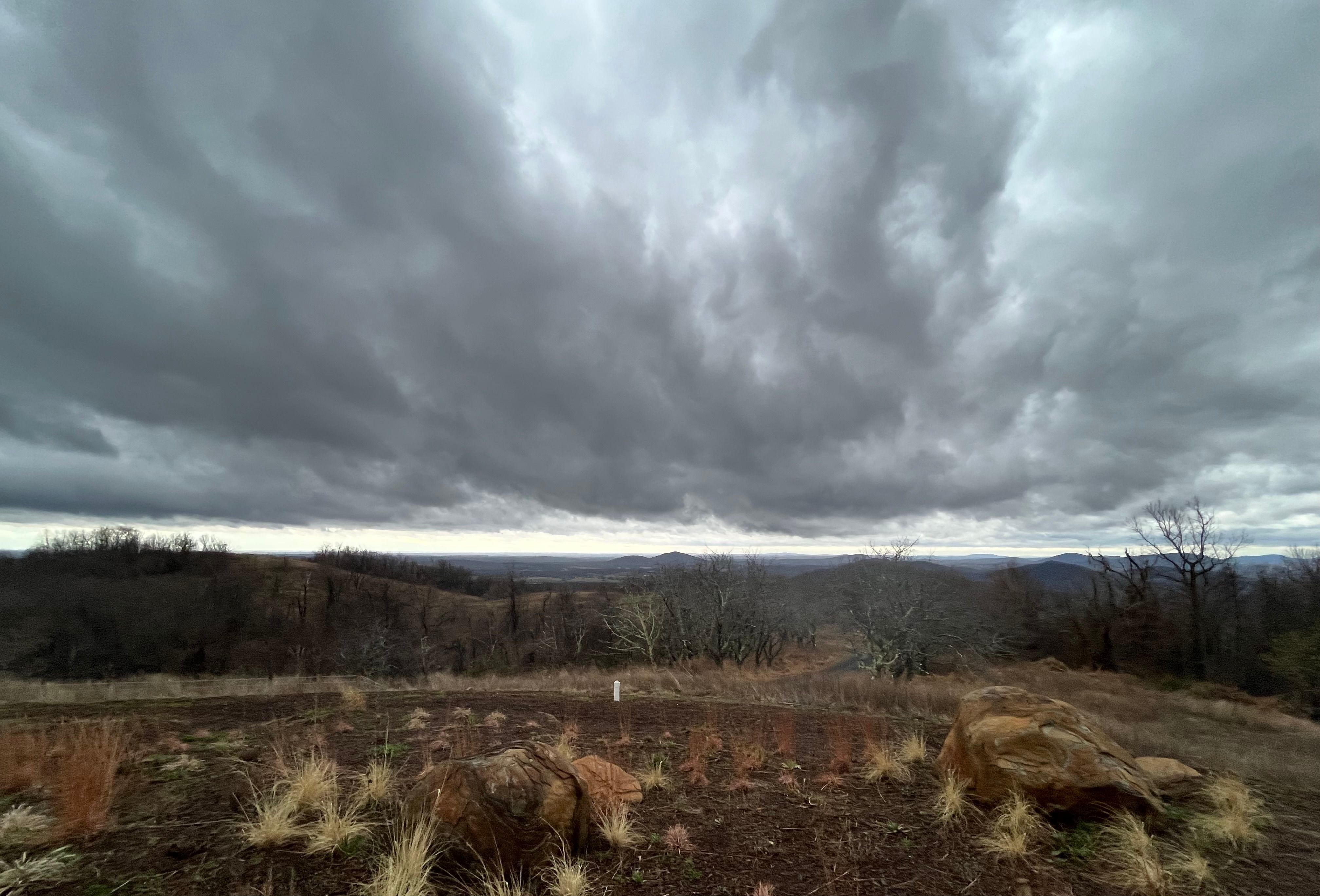
The featured photo shows the dense, dark, heavy clouds of a mid-March storm rolling in low across the mountaintop. That day brought two tornado warnings in our area and some pretty serious winds.
The Official Mountain Poodle
Would you believe that Cleo turned 7 years old this month? I remember when she was a tiny puppy. She told me that it’s her birthday, and she refuses to be overshadowed by goats. Why does eating plants make them so special, anyway? she wants to know. She can eat plants, too! (And then throw up.)

Puppy Cleo used to enjoy rolling in the vinca in our suburban yard. (This was before I knew vinca was a noxious weed.)

Here she is at 7, waiting for the sunset with me, while intently smelling all the animal smells of spring.
Now’s a good time to subscribe for more mountain discoveries, book news, and the requisite poodle photos.
Thanks for joining me on the mountain!
Until next month—
Paula W.
Bad Naturalist: One Woman’s Ecological Education on a Wild Virginia Mountaintop
Now available in hardcover, audiobook, and e-book everywhere books are sold!
You can also…
Reply