- Bad Naturalist Newsletter
- Posts
- Resolutions, Anyone?
Resolutions, Anyone?

Paula Whyman
January 09, 2026
Geek out with me about critters and plants on a mountaintop in Virginia. I’ll share what I’m learning as I try to bring native plants back on 200 acres of old farmland and tell stories from my encounters on the mountain.
Want to subscribe? (It’s free!)
Want to read it first? (I don’t blame you.)
In this issue
Field notes: Bats! Bats! Bats! (Redux)
Signs of life: January is for coralberry
Recommended reading
Book news
Mystery solved!
The Official Mountain Poodle
I’ve written a book about what I’m doing and what I’m discovering here on the mountain…
BAD NATURALIST: One Woman’s Ecological Education on a Wild Virginia Mountaintop
Have I mentioned, BAD NATURALIST is a
Finalist for the Philip D. Reed Environmental Writing Award (!)
Field Notes
Bats! Bats! Bats! (redux)
You may remember that over the summer, Erin Shibley, a biologist with Virginia Working Landscapes, ran a pilot study to find out what species of bats are living on the mountain. Now the results are in, and there were at least eight species detected, four of which are species of concern in Virginia. The fact that these bats are here makes me feel good about the work we’ve been doing for the native ecosystem.
As I mentioned in an earlier newsletter, an ultrasonic microphone was set up in one of the meadows to record bat calls as they passed. Here’s what a spectrogram image of bat calls looks like. This image shows the sounds made by a tricolored bat:
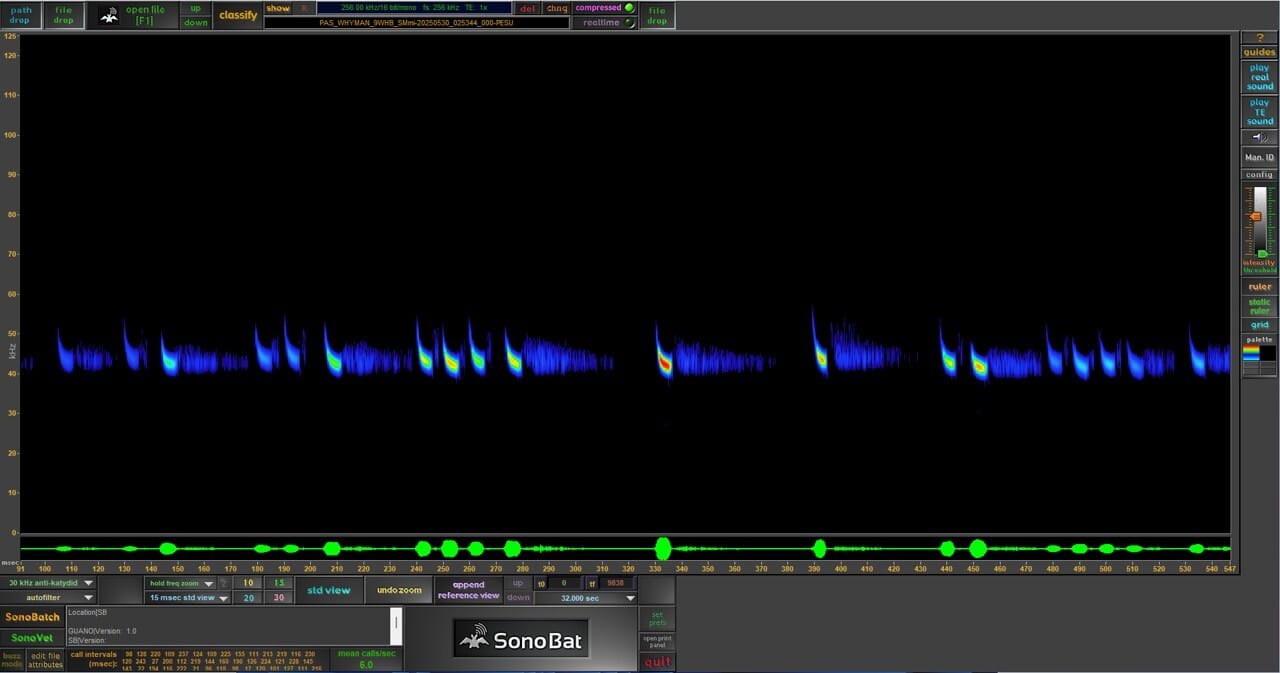
Spectrogram recording: x axis= time (milliseconds) / y=frequency (kHz)
The tricolored bat is listed as endangered in Virginia, as well as in some other states and in Canada, and was proposed for listing as a Federally endangered species in 2022. It is one of the species most threatened by White Nose Syndrome (WNS), a nonnative fungus that was first documented in North America 20 years ago. As of 2022, WNS had killed 90 percent of the tricolored population in only 10 years. At least two other bat species that used to be common experienced similar population declines, and at least a dozen species have been attacked by WNS.
This bat hibernates in caves and culverts and roosts in a variety of places, like tree cavities and rock crevices (we have plenty of those!). It normally roosts alone, which is unusual, and it hibernates early and emerges late. Its long hibernation contributes to its susceptibility to the fungus, which interferes with normal hunting behavior and can cause a bat to try to hunt in the middle of winter instead of hibernating. Ninety to one hundred percent of bats who contract WNS will die from it.
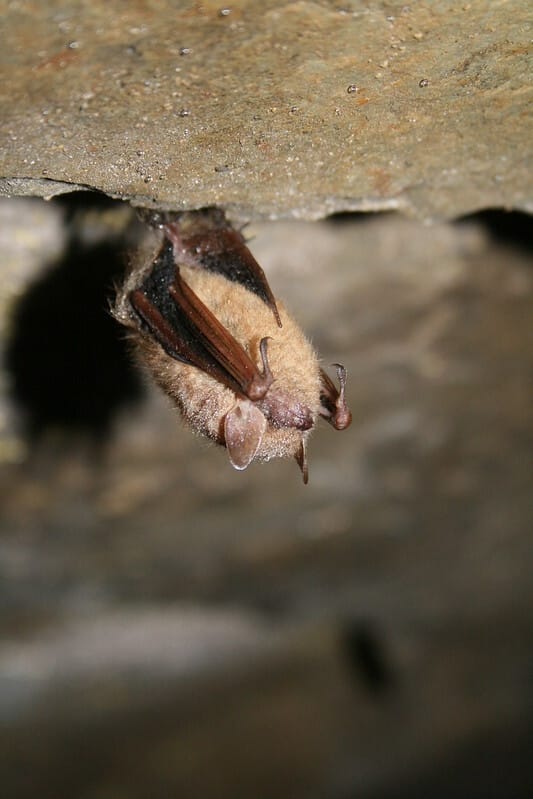
Cute, right? photo by Ann Froschauer/USFWS (via Flickr)
The tricolored bat can catch an insect every two seconds. A bat will eat half of its body weight in insects every day, and if it’s pregnant or nursing, it can eat its full body weight. A study in Iowa estimated that bats prevent one billion dollars in annual crop damage. If you’d like to benefit from this free, natural pest control, you could add a bat box to your yard. But the two biggest things you can do to encourage bats to eat your bugs are: stop spraying pesticides in your yard, and turn off your outdoor lights at night.
Pesticides, e.g., for mosquito control, kill a lot more than their target species and can cause harm to the very predators who help control pests in the first place. So, spraying for mosquitoes can actually make your pest problem worse.
As for lighting, bats wait until dusk to emerge and begin to hunt, and they’ll often make more than one foray during the night. The tricolored bat is one of the first to emerge at dusk, and it usually hunts again at around midnight. If your yard is illuminated all night, or if you have outdoor lights that light up your trees, bats are unlikely to dine there. A bat that roosts where outdoor lighting is bright all night may not even know when it’s time to emerge from its roost to hunt, and it could starve. The good news is, all we need to do to solve that problem is turn out the lights!
Harried
In a ravine on the mountain, there is a stream that fills with frogs in the spring. It’s almost impossible to access in season because it’s surrounded by dense vegetation, but right now, with the fire break created by the DOF for a future prescribed burn, I was able to get close. This area is overgrown with stiltgrass and other nonnative grasses, and a large invasive paulownia stands at the head of the stream. While I was assessing how much work would be required to rehab this spot (a lot!), a raven started shouting at me. It was insistent, flying back and forth from tall poplars at the wood’s edge. I figured it didn’t like me wandering around the stream. But soon I understood that it wasn’t me the raven was trying to scare away. I looked up in time to see a harrier fly overhead—white underneath with black at the ends of its wings. The raven harassed it, calling, until the harrier was gone.
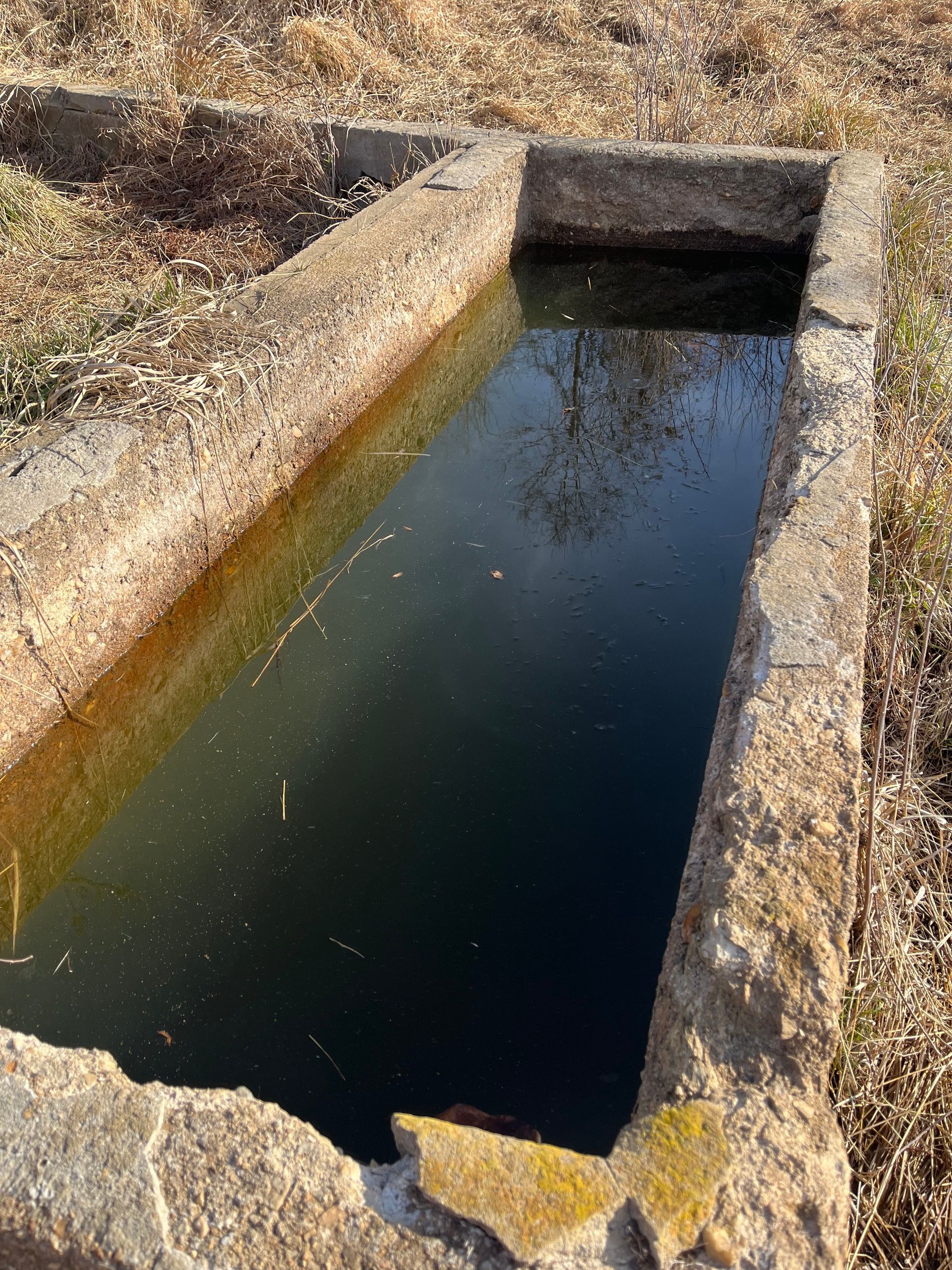
I didn’t get a photo of the harrier, so instead, I’ll show you what the stream and one of its spring boxes look like right now. Kind of a mess, right? A much older stone spring box is hidden by brush underneath that paulownia. And the stream is drier than usual. I’ve resolved to start rehabbing the stream area this winter, along with a small frog pond in another spot. Resolutions are made to be broken, but maybe I’ll be able to keep this one.
Did you make any plant- or nature-related resolutions this year? Let me know, and I’ll share them in a future newsletter.

Signs of Life
January is for coralberry
In the early winter fields, there are a few plants that stand out, like golden-orange little bluestem and burnt-brown broom sedge, and (unfortunately) the still-green invasive honeysuckle. But the plant that caught my eye on a recent walk was festooned with magenta berries. I’m talking about coralberry, a shrub that reaches three feet tall here and grows in expanding clusters. In fall and early winter, it develops small, dark pink berries (which I guess give it its name). At a time when much of the meadow is tending toward gold, the appearance of these berries seems almost festive.
I’ve noticed that some people are on the fence about whether coralberry is a good thing. It spreads easily via root suckers, expanding to form thickets, but in a meadow like this one, where it’s surrounded by other prolific native plants, it fits right in, and it doesn’t take over.
The tiny flowers seem unremarkable to me, but they attract hummingbirds; bobwhites like the fruit, and the leaves are food for the caterpillars of clearwing moths and sulfur moths. Apparently, coralberry is also one of the white-tailed deer’s favorite foods, which around here should help keep it in check. (One good thing about having so many deer.)

coralberry
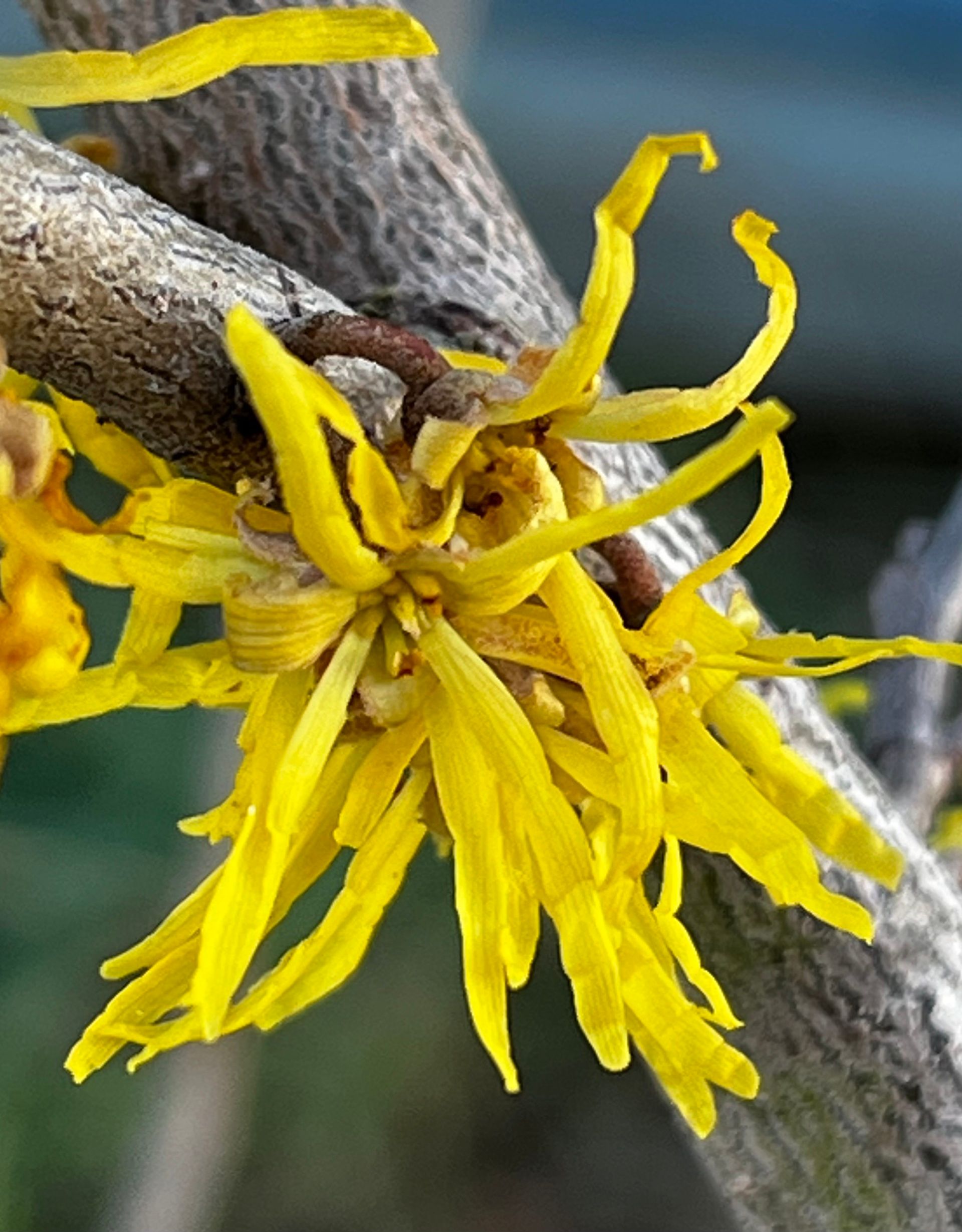
Featured photo: witch hazel
The featured photo this month is a witch hazel in bloom. There are two of these growing near our house now, just planted in November, and I was surprised to see the striking yellow flowers emerge in early December. These flowers may be fun for me to look at, but at that time of year, what could be pollinating them? One interesting answer is the owlet moth. Thanks to naturalist and writer Bernd Heinrich, we know that moths in this family are pollinating witch hazel. How do they withstand the cold? Kind of like you and me: they shiver. That raises their thorax temperature so they can flutter their wings; they can even fly in temperatures that are below freezing. (Isn’t nature wild??)
Indigenous people used witch hazel as an anti-inflammatory, a use that European colonists eventually copied, and they repurposed its forked branches for a divining rod. There are sixty-two caterpillars that use the witch hazel as a food plant. The bobwhite, the beaver, and the wild turkey are among those that enjoy its berries. (I’d love to see a beaver set up house on the mountain.)
The plant that’s pollinated in November or December won’t form seed-containing fruits until the following spring, and then in the fall, those seeds are released — they pop off of the plant and land up to thirty feet away. The seeds require cold stratification, and it will be two years before they sprout. It seems well worth the wait.
Recommended reading
You may have heard about the recent passing of environmental journalist and author Tatiana Schlossberg. (She wrote movingly about her illness in The New Yorker.) Her book, Inconspicuous Consumption: The Environmental Impact You Don’t Know You Have won the Rachel Carson Book Award. In it, Schlossberg writes engagingly and with dark humor about how things we do and buy impact global warming far beyond our doorstep. The New York Times said the book “shows how even the smallest decisions can have profound environmental consequences.”
Don’t forget to tell me about your favorite nature-related book or podcast, and I’ll share it in a future newsletter.

Mystery solved!
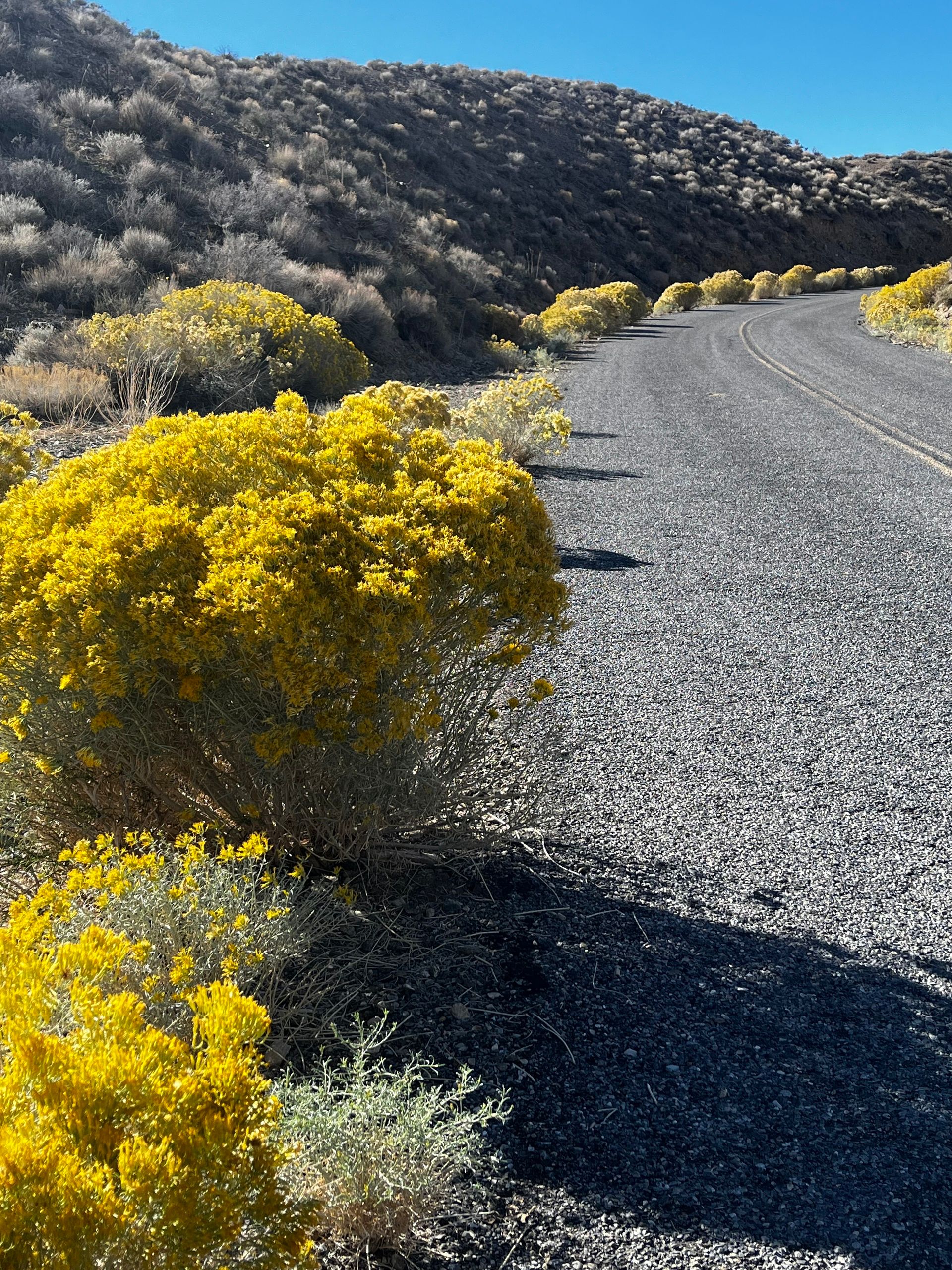
Two sharp-eyed readers identified the “bouquets” of yellow flowers lining the desert road in Death Valley. John Farnsworth in Oregon and Mary Hastings in Virginia each wrote to advise me that the plant is an aster known as Rabbitbrush or Chamisa, Ericameria nauseosa. Thank you!
Book news
Book events in January and February
Here are some events I have scheduled for the next couple of months. Please come out if you’re in the area, or consider attending a remote event.
Revalation Vineyards in Madison, VA; Book Club at the Vineyard, Jan. 23, 6pm.
Wing Haven Gardens in Charlotte, NC, Jan. 29, 10am.
Haverford College Arboretum, with Narberth Bookstore, Haverford, PA, Feb. 10, 6pm.
American Horticultural Society, remote talk, Feb. 12, 7pm.
Check my website event page, or my Instagram or Bluesky feeds for details about events, and for more interviews, podcasts, and features. If you don’t see your city or town on this list, please reach out, and I’ll see what I can do to get there!
Bad Naturalist is available wherever books are sold in stores and online, in hardcover, e-book, and audiobook formats. You can sample the audiobook here.
A special request
If you read the book in any format (and if you enjoyed it!), please post a review on the Amazon book page—it helps!
Tell me where you are and what you see this month in a park near where you live, or in your own yard or window box. Send me a photo if you like.
The Official Mountain Poodle
Cleo, about to eat snow…

Now’s a good time to subscribe for more mountain discoveries, book news, and the requisite poodle photos.
Thanks for joining me on the mountain!
Until next month—
Paula W.
Bad Naturalist: One Woman’s Ecological Education on a Wild Virginia Mountaintop
Now available in hardcover, audiobook, and e-book everywhere books are sold!
You can also…
Reply