- Bad Naturalist Newsletter
- Posts
- Snow Daze
Snow Daze

Paula Whyman
February 15, 2026

Geek out with me about critters and plants on a mountaintop in Virginia. I’ll share what I’m learning as I try to bring native plants back on 200 acres of old farmland and tell stories from my encounters on the mountain.
Want to subscribe? (It’s free!)
Want to read it first? (I don’t blame you.)
In this issue
Field notes: Snowed in
Signs of life: Bird bonus/Bug bonus
Recommended reading
Book news
The Official Mountain Poodle
I’ve written a book about what I’m doing and what I’m discovering here on the mountain…
BAD NATURALIST: One Woman’s Ecological Education on a Wild Virginia Mountaintop
Have I mentioned, BAD NATURALIST is a
Finalist for the Philip D. Reed Environmental Writing Award (!)
Field Notes
Snowed in
You may recall that last winter we had successive snowstorms and, later, an ice storm. The snow hung around for weeks, because temperatures remained below freezing. With no alternative, whenever we had to go somewhere, we walked down and back up the steep, mile-long mountain road. I found it easier to navigate in snowshoes with crampons. This meant that going to the grocery store became part Arctic trek, as I snowshoed a mile down to where I’d parked my truck before the storm and drove to the store, and then I bungie-tied the groceries to an old sled, which I pulled all the way back up the mountain. This was not ideal. So this fall, we finally obtained the all-important farm vehicle that would (we hoped) take us up and down the road when our trucks couldn’t make it. I also thought that there was no way we’d have a repeat of last winter, that, sure, it might snow, but then it would warm up and melt more quickly. We’d be stuck up here for maybe a week.
I think we all know what actually happened. In the big January storm, we got 7 inches of snow, and a significant portion of that was frozen solid, dubbed “snowcrete.” Forget shoveling with anything other than a metal shovel and/or pickaxe. Forget walking in normal snow boots; even my snowshoes didn’t break all the way through that hard layer (luckily the crampons still provided enough traction to walk). Would the farm vehicle, a UTV with chains on the rear tires, make it down and—important—back up that long, steep slope? For the first ten days, we didn’t even try it, but then work required us to leave, and we had no choice.
I’m not sure this photo really does the slope justice. Down was fine; back up was touch and go. I didn’t think we’d make it. Even with the chains, we could feel the wheels slipping at times. I thought I was going to be dragging 30 pounds of dog food up the last half-mile. I’m relieved to say that wasn’t necessary.

First trip down in the icy snow
After a snow, I usually find a variety of animal tracks. This time, the only animal that could reliably break that hard surface was the deer. Its traffic pattern was clear.
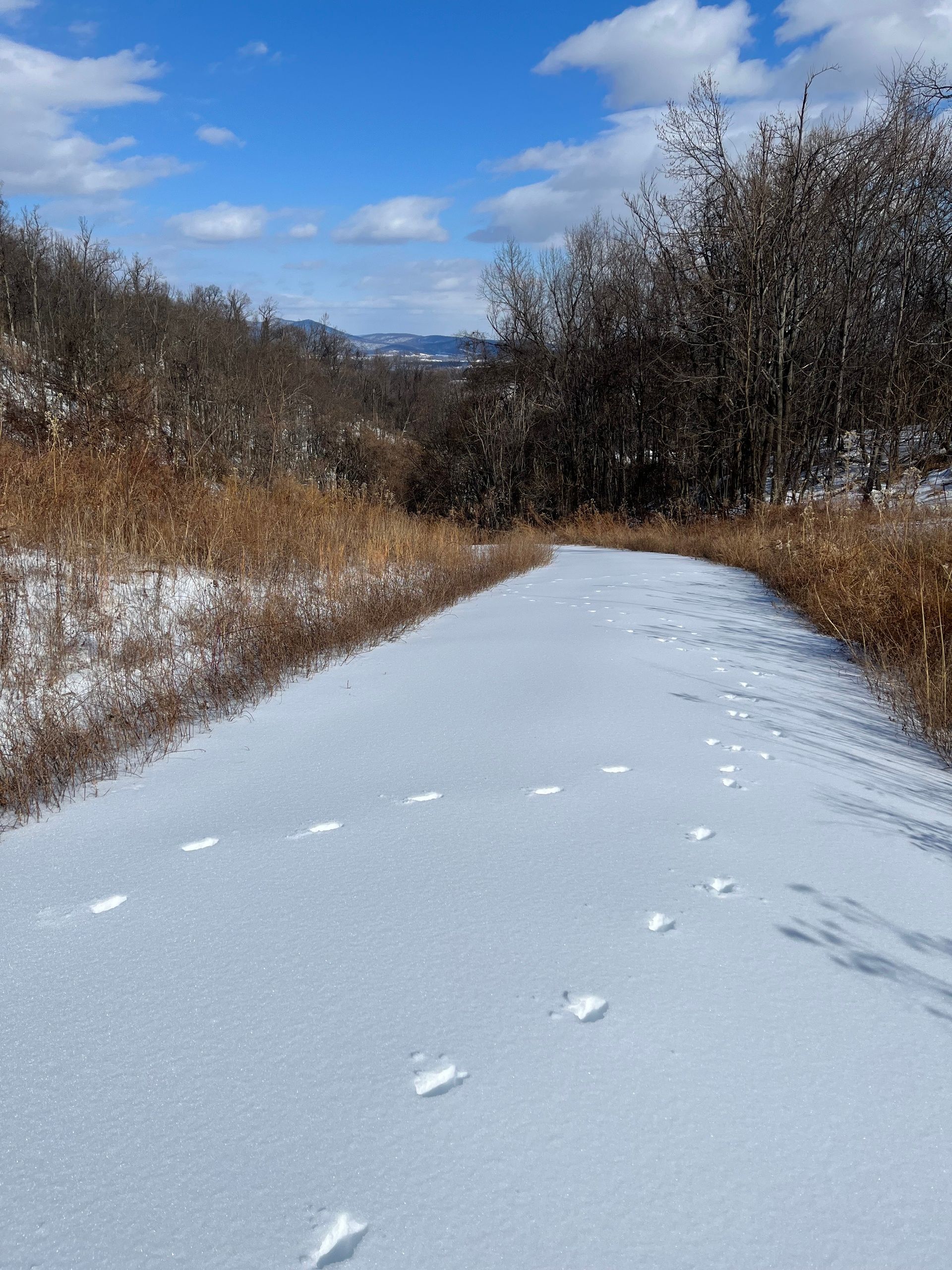
Deer tracks in fresh snow
Like last year, the temps stayed below freezing for a long time. Three weeks after the snowstorm, the snow has finally begun to melt. Even though the weather has begun to warm and the fields are losing their blanket, our road, which runs through woods and faces north, is still snow-covered and navigable only in that farm vehicle. This weekend it’s supposed to hit sixty degrees here. Maybe then?
Signs of Life
Bird bonus
Last month, I mentioned that I saw a raven chasing away a harrier while I was investigating our stream. This past few weeks, I spotted a harrier on many occasions near the house, resting in one of our orchard cherries and diving low over a fire pit. One morning, I saw a pair of harriers in my favorite tree, a chestnut oak that was damaged in last year’s ice storm. The northern harrier is the only harrier that’s native to North America, and it’s in decline in a lot of places where it used to be abundant. I found it easy to differentiate from other raptors, even from a distance, because it has a long tail with distinctive markings, and a white “rump” that’s visible when it’s in flight. When it was perched in a tree, I got a good look at its head through binoculars, and it has a uniquely owlish face. The harrier is a ground nester that likes dense fields and marshy places, which may explain why it was hanging around the stream—and why it’s interested in the mountaintop. We’ve got nothing but dense fields here. But we’re on the southern border of the bird’s breeding range, so it may just be hanging out here for the winter. I hope while it’s here, it will eat a lot of mice. But when I saw it seemed interested in the many small birds that were flocking to the hillside near my house. Bluebirds perched on boulders and white-throated sparrows and juncos picked the seeds from little bluestem and ragweed.

A male harrier; photo by Becky Matsubara at flickr
Bug bonus: a new approach to an old foe?
I subscribe to updates from APHIS, the Animal and Plant Health Inspection Service that’s part of USDA. They monitor plant and animal diseases and invasive species, among other duties. They’re the ones who decide whether it’s safe to lift a quarantine in a place where a crop has been infested with fruit flies, for instance. They’re also responsible for deciding whether it’s okay to introduce a new pest with the goal of stopping the spread of an existing one. Some of you may be aware of the mile-a-minute weevil that was intentionally introduced because it purportedly would slow or stop the spread of the noxious vine. If you have mile-a-minute on your property, you’ve probably seen evidence of those weevils—they make tiny holes in the leaves. But I’ve found that at least here on the mountain, the weevils don’t do much to arrest the growth of the vine. Oh well; at least the weevil has a good meal, I guess.
Now, APHIS has approved the introduction of a new species of weevil specifically to stop the spread of garlic mustard. Before a new species is introduced, it goes through numerous tests to make sure it won’t attack desirable plants. If you’re interested in the results of that research, you can read the entire 99-page Environmental Assessment (EA) here. The upshot is, APHIS issued a “finding of no significant impact,” aka a FONSI (not to be confused with Fonzie). That means they don’t expect the weevil to bother the plants we don’t want bothered.
I always have big concerns in these situations about Unintended Consequences. Countless species were introduced over the years under the guise of Doing Something Good and then turned out to be harmful. I always wonder whether we won’t learn something more down the road that will lead us to deeply regret such introductions. (I discuss this at length in Bad Naturalist.)
Research also had to confirm that the climate in garlic mustard’s primary range would allow the weevil to survive. The weevil in question, Ceutorhynchus scrobicollis, feeds on the plant’s leafy crown. Next, states can apply for a permit to release the weevil. I don’t know how long this part of the process takes, but I’ve got a whole mess of garlic mustard here, and, despite my doubts, I wouldn’t mind seeing what those weevils can do to it.
Buried in the EA were some interesting tidbits about garlic mustard. I knew it was invasive, that it takes over forest understories, and I suspected it was allelopathic, like so many other noxious weeds—it releases chemicals that prevent other plants from growing nearby, thus increasing the odds of a monoculture. But I didn’t know that the chemicals it releases specifically interfere with mycorrhizal fungi that native trees need to be connected with in order to grow. So garlic mustard reduces native tree presence by specifically attacking the nutrient path. Even after the weed is removed, that disruptive effect can last for up to six years. Garlic mustard not only takes over the understory, it changes the tree composition of a forest.
The plant spreads only by seed, but the average plant can produce from a few hundred up to thousands of seeds. A dense patch of garlic mustard can produce as many as 45,000 seeds per square meter.
So, bring on the weevils, I suppose, even though I worry.

Ceutorhynchus scrobicollis; photo by Patrick Deyroze, Creative Commons
Featured photo
Sunset over the Blue Ridge, as seen from the mountain a few days after the January snowstorm; native grasses in the foreground, poking up above the snow.
Recommended reading
Lindsey Liles is the winner in the journalism category of the Southern Environmental Law Center’s 2026 Reed Environmental Writing Award. Her award-winning article, “Inside the Fight to Save the World’s Most Endangered Wolf,” appeared last year in Garden & Gun magazine. (Full disclosure, so did a profile that Liles wrote about me and the mountain project!) The story of the red wolf in North Carolina is a sad one, but as this piece shows, there is still hope.
About the winning piece, the SELC says, “Through vivid reporting and careful attention to science, policy, and place, the story explores the fragile balance between wildlife conservation, land use, and public will.”
In the next newsletter, I’ll highlight the Reed Award winner in the book category, so stay tuned!

Don’t forget to tell me about your favorite nature-related book or podcast, and I’ll share it in a future newsletter.
Book news
Book events in March and April
Here are some events I have scheduled for the next couple of months. Please come out if you’re in the area, or consider attending a remote event.
Wing Haven Gardens, talk and book signing. Charlotte, North Carolina. Thursday, March 19, 2026, 10am. Registration required. [Rescheduled from January, due to the snowstorm.]
Shenandoah Valley Plant Symposium, Waynesboro, VA. Friday, March 13, 2026. 8am-3:15pm. Registration required.
The Land Conservancy of McHenry County, Annual celebration. Woodstock, Illinois. Sunday, April 12, 2026. 2-5pm. Registration required.
Here’s a shot of my event at Haverford College that took place earlier in February. It was sponsored by the Haverford Arboretum and Narberth Bookshop. The Haverford Arboretum’s nature book club read Bad Naturalist in January!

Check my website event page, or my Instagram or Bluesky feeds for details about events, and for more interviews, podcasts, and features. If you don’t see your city or town on this list, please reach out, and I’ll see what I can do to get there!
Bad Naturalist is available wherever books are sold in stores and online, in hardcover, e-book, and audiobook formats. You can sample the audiobook here.
A special request
If you read the book in any format (and if you enjoyed it!), please post a review on the Amazon book page—it helps!
Tell me where you are and what you see this month in a park near where you live, or in your own yard or window box. Send me a photo if you like.
The Official Mountain Poodle
Although she enjoyed eating the snow, navigating it was a challenge for the poodle at first—slippery! I refrained from trimming her nails so that she’d have some built-in crampons. Here she is at night, in a well-trampled (and munched) spot near the door.

Now’s a good time to subscribe for more mountain discoveries, book news, and the requisite poodle photos.
Thanks for joining me on the mountain!
Until next month—
Paula W.
Bad Naturalist: One Woman’s Ecological Education on a Wild Virginia Mountaintop
Now available in hardcover, audiobook, and e-book everywhere books are sold!
You can also…
Reply